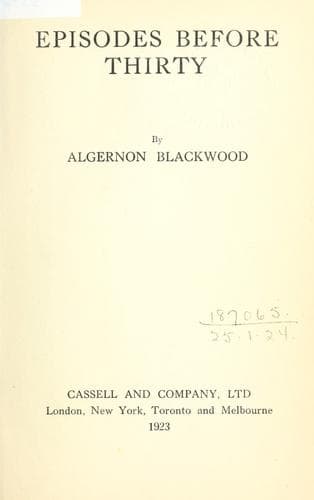
Authors, English -- 20th century -- Biography; Blackwood, Algernon, 1869-1951
He sat down in his armchair, lit his pipe, pulled up the operating
chair for me to lie on beside him, and then told me very quietly why he
took it. Already his face looked different, as the morphine circulated
through the blood, and he smiled and wore a genial happy air of
benevolence that made him at once a different man.
“I shall have peace now for several hours,” he said, “but I don’t take
morphine for pleasure. I take it because it is the only way to keep
myself alive and to keep my wife and child from starving. If I can
gradually wean myself from it I shall live for years. If not, and I
cannot make the dose less and less, it will kill me very soon. I am
old, you see.”
He told me very simply, but very graphically, speaking in German
as he loved to do, that three years ago he had enjoyed a good and
lucrative practice. But he had embarked upon some experiments in his
leg--I never understood exactly what and did not dare to ask--and to
observe these properly he was obliged to use the knife without taking
any anæsthetic. His wife stood beside him and staunched the blood,
but the pain and shock proved more than he was equal to, being an old
man, and a collapse followed. All his patients left him, for he could
not attend to them, and in order to be in a fit condition to see even
chance callers he had to inject morphine. Thus the habit began, and
before he knew where he was the thing had him by the throat. He was a
man of great natural strength of will and he began to stop it, but the
fight was far harder than he had imagined, and his nerves seemed to
have gone to pieces. Unless he had the support of a dose, he was so
brutal, irritable and rude that no one could stay in his presence, and
no patient would come near him. He never got his practice back again,
and whenever a stray patient called now he had to take an injection, or
he would be sure to behave in such a way that the man or woman would
never return. He used atropine to mix with his morphine, and thus tried
gradually to cure himself, and lately had succeeded in reducing the
quantity very considerably, but it was an awful fight, and he admitted
the end was uncertain. He said I helped him to bear the strain. My
presence, he said, the music too, gave him some sort of comfort and
strength, and he was always glad to see me. When I was there he could
hold out longer than when he was alone, and one reason he was telling
me all this intimate history--telling it to a comparative stranger--was
because he wished me to try and help him more.
I stammered some words in broken German about being eager and willing
to help, and he smiled and said he thanked me and “we would make the
fight together.”
Public-domain text, read in full here on John Shaqi.
Reviews
Reviews
No reviews yet
Be the first to share your thoughts on this work.
Elsewhere in the archive
Join the Discussion
Join the discussion
Sign in to leave a comment or review.
Sign InorCreate an account