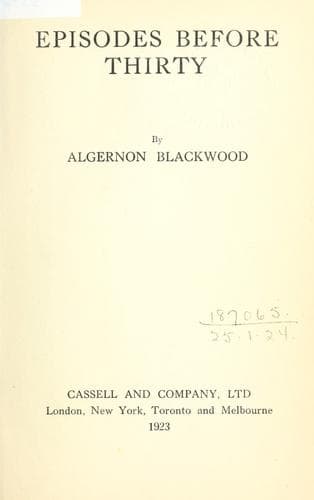
Authors, English -- 20th century -- Biography; Blackwood, Algernon, 1869-1951
“The charm is very powerful,” he went on, “especially to a nature like
mine, for when I take this stuff the world becomes full of wonder
and mystery again, just as it was for me sixty years ago when I was
a boy with burning hopes and high dreams. But far more than that, I
_believe in people_ again. That makes more difference in your life than
anything else, for to lose faith in men makes life unbearable. Bitter
experiences have shaken my trust and belief in my fellow creatures. But
with this stuff in me I find it again and feel at peace with the world.”
“That is why you sometimes approve and at other times disapprove of my
attitude towards Boyde?”
“Yes,” he said, with a most benign and delightful expression in his
eyes. “Give him every chance. There’s lots of good in him. He feels, no
doubt, that everyone who knows about him distrusts him. Weak men will
always try more or less to live up to what is expected of them, for
they are easily hypnotised. If they feel every one expects only evil
from them their chief incentive is lost.”
“Then I ought never to let him think I’ve lost belief in him?”
“Never. Frighten him, kick him, urge him along with violence, anything
to make him move of himself towards being decent; but never suggest he
_cannot_ be, and _is not_, decent and straight.”
How we talked that night--and how I suffered from hunger, for when
morphine was in him the old doctor ate little, and this time he was
full of ideas and ideals, and had so sympathetic a listener, that he
forgot I might want food, and it was not till after one in the morning
that he began to flag and thought of coffee. We went down into the
kitchen, and there we found the patient wife dozing on the wooden
chair, and the child reading a book--“Undine”--on the deal table, with
her eyes so bright I thought they were going to shoot out flame. She
looked up and stared at us for a long time before she got herself back
from that enchanted region of woods and pools and moonlight.... Strange
supper parties they were, in that quiet, basement-kitchen between one
and two of the winter mornings of December, 1892....
Otto Huebner, having broken the ice, told me much of his own life then.
Owing to family disputes he left the manufacturing town in Northern
Germany where he was born and brought up, and came to New York as a
young man. He never saw his parents again, and took out naturalization
papers at once. For years he was employed by Steinway’s piano factory,
as a common workman at first, then as a skilled man. He was unmarried,
he saved money, he began to study at night; the passion for medicine
was so strong in him that he made up his mind to become a doctor. He
attended lectures when he could. It was a life of slavery, of incessant
toil both day and night. He was over forty when he began studying for
the examinations, and it took him seven years to attain his end. His
health had suffered during this strenuous time. He had married well
after fifty....
Public-domain text, read in full here on John Shaqi.
Reviews
Reviews
No reviews yet
Be the first to share your thoughts on this work.
Elsewhere in the archive
Join the Discussion
Join the discussion
Sign in to leave a comment or review.
Sign InorCreate an account