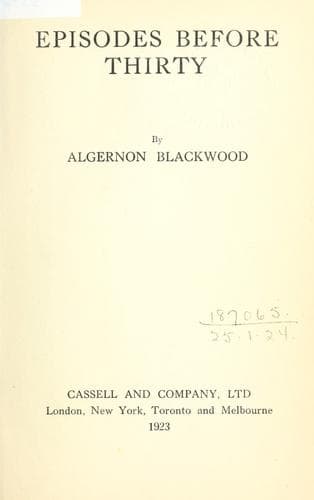
Authors, English -- 20th century -- Biography; Blackwood, Algernon, 1869-1951
daughter that you tried to prevent our meeting because you wished
me to marry one of your sisters, though I do not know, of course,
whether you have any even. That, and the taking the stamps off
your letters so that I could get beer, seem to weigh most heavily
with me now in my darkness and loneliness. I do not know what my
sentence will be--heavy, I suspect, unless I can get someone to
plead for me, and I have not a single solitary friend to do that.
I am utterly alone. I have been in this cell now twenty-one days,
and have a week more before sentence is given. It seems like six
months. No one can realize what prison is like till they have tried
it.
Believe me, I am deeply and truly sorry. I speak from my heart.
Think of me as kindly as you can when I am in the Penitentiary. I
hope I shall see you once more.
ARTHUR B.
I saw Boyde twice in my life afterwards; I heard, indirectly, from him
once: the prison chaplain wrote to ask for “his things” which, Boyde
told him, I “insisted upon keeping.” He never had any “things” at all
while I knew him; the letter was indignant and offensive. Boyde had
evidently “told a tale” to the chaplain.
The first time I saw him was some eighteen months after he had been
sent up, good behaviour evidently having shortened his term. I was
walking up Irving Place and saw him suddenly about fifty yards in front
of me. It was my own thick suit I recognized first, then its wearer. I
instinctively called out his name. He turned, looked at me, hurried on,
and went round the corner into 21st Street. Once round the corner, he
must have run like a hare, for when I entered the street too, he had
disappeared.
The second, and last, time I saw him was in London ten years later--at
a bookstall in Charing Cross station. He saw me, however, first, or
before I could come close enough to speak, and he melted away into the
crowd with swift and accomplished ease. I was near enough, though,
to note that he had grown his heavy moustache again, still wore his
eyeglass, and was smartly, even prosperously, dressed. He looked very
little older. From Lynwood Palmer, whom I met soon afterwards in
Piccadilly, I heard that my old employer, the Horse, had seen him at
Tattersalls not long before, and that he, Boyde, had come and begged
Palmer not to give him away as he was “after some Jews only”! Artist
Palmer took no action.
CHAPTER XXV
McCloy took me back on the _Evening Sun_, according to his promise,
about mid-January, and about the same time Mrs. Bernstein sold her
house and moved to another lower down the street, almost opposite to
the doctor’s. There were no insects, all our things were out of pawn,
we had overcoats again, but we had to find a new Ikey, for the old
Ikey, of course, would have nothing more to do with our trousers,
gladstone bag, top hat and tennis cups.
Public-domain text, read in full here on John Shaqi.
Reviews
Reviews
No reviews yet
Be the first to share your thoughts on this work.
Elsewhere in the archive
Join the Discussion
Join the discussion
Sign in to leave a comment or review.
Sign InorCreate an account