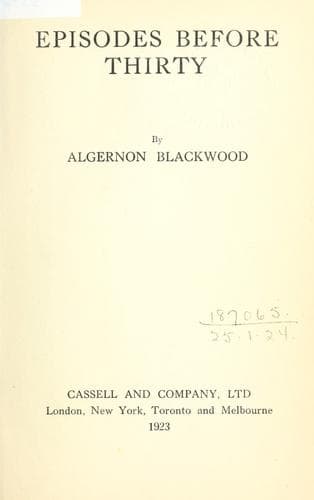
Authors, English -- 20th century -- Biography; Blackwood, Algernon, 1869-1951
The East 19th Street chapter was closed when Boyde went to Blackwell
Island; another in the same street had begun: Mrs. Bernstein begged
us to move with her: we owed her big arrears of rent; also, for some
odd reason, she really liked us. In her odd way she even tried to
mother me, as though her interest, somewhere perhaps her pity too,
were touched. “You haf had drouble in England, I subbose?” she hinted
sympathetically. She had read the newspapers carefully, and could not
understand why I should be exiled in poverty in this way unless I had
done something shady at home. It followed that I had been sent out
to America for my country’s good. She shared, that is, the view most
people took of my position in New York.
Only three months had passed since we arrived, but it seemed years. I
had never lived anywhere else. The sheltered English life, the Canadian
adventures, above all the months upon our happy island, lay far away
down the wrong end of a telescope, small, distant patches, brightly
coloured, lit by a radiant sun, remote, incredible. It was not myself
but another person I watched moving across these miniature maps of
memory. Those happy days, states, places, those careless, sanguine
moods, those former points of view so bright with hope, seemed gone for
ever. I now lived in a world where I belonged. I should never climb
out again.
The intensity of emotion at the time is difficult to realize now, and
quite impossible to recapture. I only know that my feelings burned
like fire, all the fiercer, of course, for being inarticulate. The
exaggeration was natural enough; everything was out of proportion in
me: Boyde had destroyed my faith in people. I believed in no one. The
doctor had said that to lose belief in others made life insupportable.
I found that statement true. There was a deep bitterness in my heart
that for a time was more than I could manage, and this distrust and
bitterness led me into an act of cruelty that shames me to this day.
Into the roar and thunder of that frenzied newspaper office stole a
hesitating figure one afternoon, a shy youth with rosy cheeks and
curly hair, dressed in shabby but well-cut clothes, and obviously an
Englishman. He wore gloves and carried a “cane”; these marked him
as a “Britisher” at once. He was asking for someone; fingers were
pointed at me; he was faintly familiar; I had seen the face before--but
where? He came over and introduced himself as Calder, son of a Midland
coach-builder; we had met at some place or other--outside a studio
door, I think--and he knew Kay. I forget what he was doing in New
York---idling, I think, or travelling. He had outlived his cash, at any
rate. He was in difficulties. I distrusted him instantly. He was, of
course, another Boyde. I gave him the curtest possible greeting. He, in
turn, found the greatest possible difficulty in telling me his story.
Public-domain text, read in full here on John Shaqi.
Reviews
Reviews
No reviews yet
Be the first to share your thoughts on this work.
Elsewhere in the archive
Join the Discussion
Join the discussion
Sign in to leave a comment or review.
Sign InorCreate an account