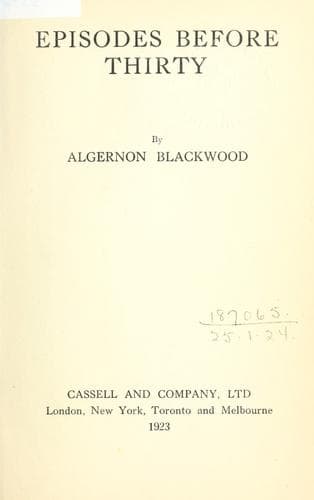
Authors, English -- 20th century -- Biography; Blackwood, Algernon, 1869-1951
I was sitting at the reporters’ table in shirt-sleeves (owing to the
suffocating temperature of the over-heated office), scribbling at
top speed the details of some lurid “story,” while Calder told me
his tale. He wanted to whisper, but the noise forced him to shout,
and this disconcerted him. No one listened, however; he had merely
brought a “story” in. He had--but it was his own story. I have quite
forgotten what it was, or what had happened to him; only the main point
I remember: he had nowhere to sleep. Of his story I did not believe
a single word, though I did believe that he had no bed. “Can I bunk
with you to-night?” he came finally to the point. I told him he most
certainly could not. He refused to believe me. I assured him I meant
it. I was his last hope, he said, with a nervous grin. I told him to
try a doss-house. He grinned and giggled and flushed--then thanked me!
It would only be for a night or two, he urged. “You can’t possibly
let me walk the streets all night!” I replied that one Boyde had been
enough for me. I had learnt my lesson, he could walk the streets for
the rest of his life for all I cared. He giggled, still refusing to
believe I meant it. His father was sending money. He would repay me.
He went on pleading. I again repeated that I could not take him in. He
left, still thanking me and blushing.
Visions of another Boyde were in my mind. At the time, moreover, our
poverty was worse than it ever had been. Boyde, I found, had sold six
of my French stories to McCloy at $5 each, and had pocketed the money.
My salary was now being docked five dollars each week till this $30
was paid off. We had, therefore, only ten dollars a week between the
two of us. Everything was in pawn again, and times were extra hard. To
have Calder living on us was out of the question, for once he got in we
should never get him out. I was tired of criminal parasites.
It was my head that argued thus; in my heart I knew perfectly well that
Calder was guileless, innocent as milk, an honest, feckless, stupid
fellow who was in genuine difficulty for the moment, but who would
never sponge on us, and certainly do nothing mean. Conscience pricked
me--for half an hour perhaps; in the stress and excitement of the day
I then forgot him. That evening Acton Davis, the dramatic critic, gave
me a theatre seat, on condition that I wrote the notice for him. It was
after eleven when I reached home. Curled up in my bed, sound asleep,
his clothes neatly folded on the chair, lay Calder.
Public-domain text, read in full here on John Shaqi.
Reviews
Reviews
No reviews yet
Be the first to share your thoughts on this work.
Elsewhere in the archive
Join the Discussion
Join the discussion
Sign in to leave a comment or review.
Sign InorCreate an account