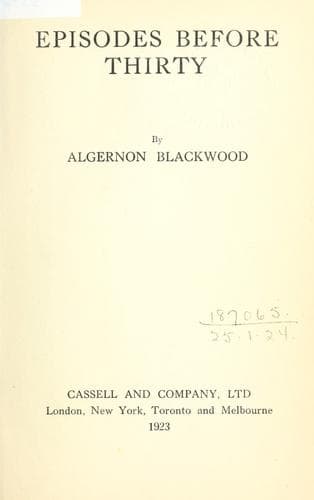
Authors, English -- 20th century -- Biography; Blackwood, Algernon, 1869-1951
Among the “incidents” that stand out from the dim, miserable smudge of
fifteen months, is one that centres about a strange figure, and a most
lovable fellow, named Angus Hamilton. Various odd fish drifted on to
the paper as reporters, and drifted off again; they form part of an
unimportant kaleidoscope. But Angus Hamilton, with his generosity, his
startling habits, his undoubted ability, his sad and sudden end, stands
out.
My position had improved since the publication of the Boyde story,
chiefly, of course, because of the way the peerage had been dragged
into its details and its headlines. I received no advance in salary,
but I received an advance in respect. Even McCloy was different: “Why
waste your time with us?” he spat at me like a machine-gun with a rapid
smile. “Go home. Collect a lot of umbrellas and turned-up trousers and
letters of introduction. Then come out to ‘visit the States,’ marry
an heiress, and go home and live in comfort!” He was very lenient to
my numerous mistakes. Other papers “got a beat” on me, I “fell down”
times without number, I failed to get an interview with all and sundry
because I could not find “the nerve” to intrude at certain moments into
the lives and griefs of others. But McCloy winked the other eye, even
if he never raised my pay. Other men were sacked out of hand. I stayed
on. “You’ve got a pull with Mac!” said “Whitey.” New men took the
places of the lost. Among these I noticed an Englishman. Cooper noticed
him too. “Better share an umbrella and go arm in arm,” he said in his
good-natured way. “He’s a fellow-Britisher.”
Why he came to New York I never understood. He was a stepson of
Pinero, the playwright, and he received occasional moneys from Daniel
Frohman, by way of allowance, I supposed, though I never knew exactly.
Clever though he was, he was a worse reporter than myself--because he
didn’t care two straws whether he got the news or did not get it. He
had a “pull” of some sort, with Laffan probably, we thought. He came
to our boarding-house in East 19th Street. He had a bad stammer. His
methods of reporting were peculiar to himself. Often enough, when sent
out on a distasteful assignment, he simply went home. He had literary
talent and wrote well when he liked. When Frohman handed out his money,
he spent it in giving a big dinner to various friends, though he never
included Kay, Louis, or myself among his distinguished guests. We had
no dress-suits, for one thing.
Public-domain text, read in full here on John Shaqi.
Reviews
Reviews
No reviews yet
Be the first to share your thoughts on this work.
Elsewhere in the archive
Join the Discussion
Join the discussion
Sign in to leave a comment or review.
Sign InorCreate an account