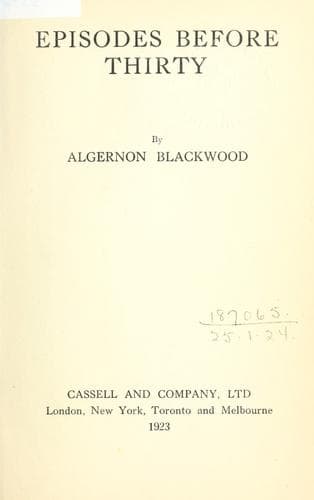
Authors, English -- 20th century -- Biography; Blackwood, Algernon, 1869-1951
[2] “The Interpreters,” by A. E. The characters “interpret” the
“relation of the politics of Time to the politics of Eternity.”
“No, no,” replies the poet. “The earth spirit does not draw us aside
from life. How could that which is father and mother of us all lead us
to err from the law of our being?”
And, again, as I sat puzzling about the amazing horror of what was
called the Civilization of the New World, and doubtless making the
commonplace mistake of thinking that New York City was America:--
“Every great civilization, I think, has a Deity behind it, or
a divine shepherd who guided it on some plan in the cosmic
imagination. ‘Behold,’ said an ancient Oracle, ‘how the Heavens
glitter with intellectual sections.’... These are archetypal images
we follow dimly in our evolution.”
“How do you conceive of these powers as affecting civilization?”
“I believe they are incarnate in the race; more in the group than
in the individual; and they tend to bring about an orchestration of
the genius of the race, to make manifest in time their portion of
eternal beauty....”[3]
[3] _Ibid._
My conception of the universe, at any rate, in these early days
was imaginative entirely; the critical function, which comes with
greater knowledge, with reason, with fuller experience, lay wholly
dormant. I communed with both gods and devils. New York stoked the
furnace--provided the contrasts. Experience, very slowly, furnished the
files and sand-paper which lay bare what may be real beneath by rubbing
away the pretty gilt. Certain convictions of those far days, however,
stood the test, whatever that test may be worth, and have justified
themselves to me with later years as assuredly _not_ gilt. That unity
of life is true, and that our normal human consciousness is but one
type, and a somewhat insignificant type at that, hold unalterably
real for me to-day. My other conviction, born in Bronx Park in 1892
by the teapot, tin mug, and familiar boulder which concealed these
indispensable utensils during the week, is that the Mystical Experience
known to many throughout the ages with invariable similarity is _not_ a
pathogenic experience, but is due to a desirable, genuine and valuable
expansion of consciousness which furnishes knowledge normally ahead
of the race; but, since language can only describe the experience of
the race, that it is incommunicable because no words exist, and that
only those who have experienced it can comprehend it. The best equipped
modern “intellectual” (above all the “intellectual” perhaps), the most
advanced scientist, as, on the other hand, the drayman, the coster, the
city clerk, must remain not only dumb before its revelation, stupid,
hopelessly at sea, angry probably, but contemptuous and certainly
mystified: they must also appear, if they be honest, entirely and
unalterably _sceptical_. Such scepticism is their penalty; it is,
equally, their judge and their confession.
CHAPTER XXVI
Public-domain text, read in full here on John Shaqi.
Reviews
Reviews
No reviews yet
Be the first to share your thoughts on this work.
Elsewhere in the archive
Join the Discussion
Join the discussion
Sign in to leave a comment or review.
Sign InorCreate an account