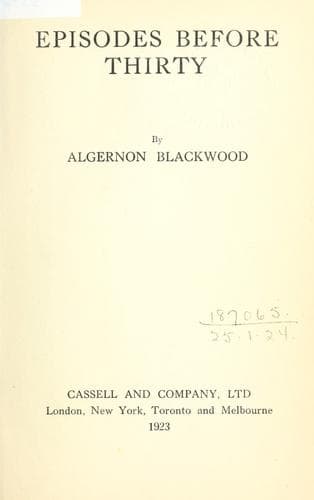
Authors, English -- 20th century -- Biography; Blackwood, Algernon, 1869-1951
The personality of Alfred H. Louis is identified with New York for
me; he accompanied my remaining years there, guide, philosopher and
friend. He took in hand that indiscriminate heterogeneous reading
which the Free Library made possible. He proved an unfailing and
inspiring counsellor. How, why or whence he came to be in America at
all I never knew. One thing that stirred him into vehemence, when the
past was mentioned, was the name of Gladstone. With flashing eyes and
voice of thunder he condemned the Grand Old Man, both as to character
and policy, in unmeasured terms. Gladstone, apparently, had done him
a personal injury as well. “We cannot let that man come among us,”
was Gladstone’s dictum, when Louis’s name was being considered as
a candidate for Parliament by the Party. “He is too earnest.” This
fragment was all he ever told me, but there lay evidently much behind
it. “_Too earnest!_” he repeated with contemptuous indignation.
Of his days at Cambridge he was more communicative, though,
unfortunately, I kept no notes. The eloquence and earnestness of his
speeches at the Union, when Sir William Harcourt was president, made,
according to his own account, a great stir. Of Dr. (Bishop) Lightfoot,
of Benson, afterwards Archbishop, he had intimate memories, coloured
by warm praise. His book on “England’s Foreign Policy” (Bentley, 1869)
apparently angered Gladstone extremely, and Louis’s political career
was killed.
He was called to the bar. Of success, of important cases, he told
me nothing. His early brilliance suffered, I gathered, a strange
eclipse, and from things he hinted at, I surmised--I cannot state it
definitely--that a period in some kind of _maison de santé_ followed
about this time. That he had been, then or later, in an asylum for the
insane, I heard vouched for repeatedly in London years later. For an
interval before the breakdown came, he was editor, or part-editor, of
the _Spectator_, and in some similar connexion, as owner or editor,
he served the _Fortnightly_ too. George Eliot he knew well, giving me
vivid descriptions of her famous Sundays, and of his talks with George
Henry Lewes and Herbert Spencer. He claimed to be the original of
Daniel Deronda. He was a pupil of Sterndale Bennett’s on the piano. Of
his friendship with Cardinal Manning he had also much to tell.
Public-domain text, read in full here on John Shaqi.
Reviews
Reviews
No reviews yet
Be the first to share your thoughts on this work.
Elsewhere in the archive
Join the Discussion
Join the discussion
Sign in to leave a comment or review.
Sign InorCreate an account