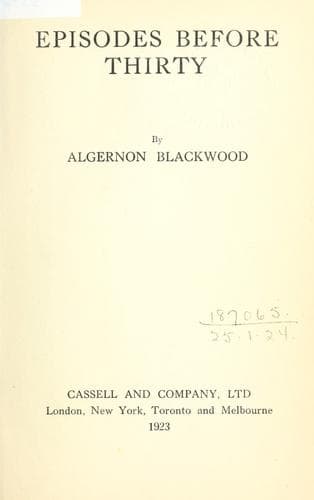
Authors, English -- 20th century -- Biography; Blackwood, Algernon, 1869-1951
In his single room, at any rate, where a piece of furniture against
the wall covered with framed photographs of German notabilities was
in reality a folding-bed--I never once, since the oysters, betrayed
that I knew this--he lived “like a gentleman.” Every night, from nine
o’clock onwards, he was “at home”; a box of cigars, various liqueurs,
he offered without fail, and “with an air” if you please, although
the former never held more than three or four cigars, the bottles
never more than enough to fill two glasses, because “my servant,
confound him, has forgotten again to fill them.” He had no servant,
of course, and the minimum of replenishing was done by himself every
evening before nine o’clock. “Then you are a Baron really?” I said
once, referring to the “von” before his name. He looked at me with the
disdainful smile a prince in difficulties might have worn: “In this
city of snobs and scoundrels,” he said lightly, “I have dropped my
title. The ‘von’ alone I find more dignified.” He left the house, I
found, every morning sharp at eight, and this was in favour of Brodie’s
theory that he had some regular job. He was an experienced, much-lived
old bird, a touch of something sinister about him always, about most
of his friends as well. Some very disagreeable types I surprised more
than once in his well-furnished room. He “knew the ropes,” knew men
and women too, his counsel was always sound in worldly matters. A lack
of humour was his chief failing, it seemed to me, while his snobbery
was another weakness that probably led many of his schemes to failure.
Every summer, for instance, he would go for two weeks to Newport, where
the rank and fashion went. “When I was at Newport,” or “I am going to
Newport next week,” were phrases his tongue loved to mouth and taste
like fine wine. But his brief days there were spent actually in a cheap
boarding-house, although the letters he wrote to all and sundry, to
myself included, bore one word only as address: “Newport,” made from a
die, at the head of his coloured paper.
It was von Schmidt, then, who warned me about Brodie and his
eau-de-Cologne business: “He is a fool, a peasant. There will be
trouble there. Do not identify yourself with him or his business. It
is not worth while....” And his manner conveyed that he could tell
something more definite if he liked, which I verily believe was the
case. Brodie, I was convinced later, paid him tribute.
I began to feel uncomfortable. One day I asked Brodie, point blank,
what his recipe was and how he came by it? “That’s me own beezness,”
he replied. “There’s nothing to be nairvous about.” I consulted “old
Louis.” “If you feel the faintest doubt,” was his answer, “you should
leave at once.” I decided to get out. Brodie asked me to wait the
current month. I agreed.
Public-domain text, read in full here on John Shaqi.
Reviews
Reviews
No reviews yet
Be the first to share your thoughts on this work.
Elsewhere in the archive
Join the Discussion
Join the discussion
Sign in to leave a comment or review.
Sign InorCreate an account