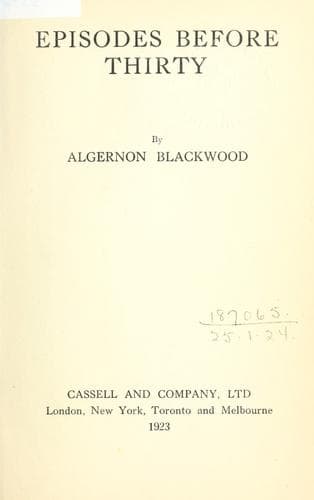
Authors, English -- 20th century -- Biography; Blackwood, Algernon, 1869-1951
The plague of possessions, at any rate, has never troubled me, either
actually or in desire, while the instinct to reduce life to its
simplest terms has strengthened. The homeless feeling of living in my
trunks is happiness, the idea of domesticity appals, and the comforts
of rich friends wake no echo in me, assuredly no envy. A home, as a
settled place one owns and expects to live in for years, perhaps for
ever, is abhorrent to every instinct in me, and when acquaintances
show off with pride their cottage, their flat, their furniture, their
“collections,” even their “not a bad little garden, is it?” my heart
confesses to a vague depression which makes it difficult to sympathise
and give them my blessing. Life, at its longest, is absurdly brief
before health and energy begin to slip downhill; it is mapped with
a cunning network of ruts and grooves from which, once in, it is
difficult to escape; only the lucky ones are never caught, although the
“caught” are lucky perhaps in another way--they do not realize it. Yet
even to-day, when times are bad and the horizon not too clear for some
time ahead, the old dread of starvation rises in me; I never see apple
rings in a grocer’s window without getting their taste and feeling them
rise and swell within me like some troublesome emotion....
To my year and a-half on the _New York Times_ I look back with nothing
but pleasure; the slogan, “All the news that’s fit to print,” was
practised; and the men I worked with were a good company of decent
fellows. Muldoon, a fighting Irishman with a grim fierce manner and
a warm heart, had a sense of humour and a gift for encouraging his
reporters that made them love him. C. W. Miller was editor in chief,
and Carey, manager. Who owned the paper I have forgotten, but it was
not Colonel Jones who was present at the Union League Club dinner to
my father, when I made my maiden speech some nine years before. Hours
of work were from noon until the night assignment was turned in, which
meant any time from ten o’clock onwards; though, as emergency man, in
case of something happening late, I often had to stay in the office
till after one in the morning. Proper food, a new suit, comradeship
with a better class of men, came, perhaps, just in time for me. I
remember the pleasure of writing home about my new post. I had a
dress-suit again. I saved $15 a week.
Reporting for a New York newspaper can never be uneventful, but the
painful incidents of life make deeper impressions than the pleasant
ones. To meet the former means usually to call upon one’s reserves,
and memory hence retains sharper pictures of them corresponding to the
greater effort. On the _Times_ I was happy.
Public-domain text, read in full here on John Shaqi.
Reviews
Reviews
No reviews yet
Be the first to share your thoughts on this work.
Elsewhere in the archive
Join the Discussion
Join the discussion
Sign in to leave a comment or review.
Sign InorCreate an account