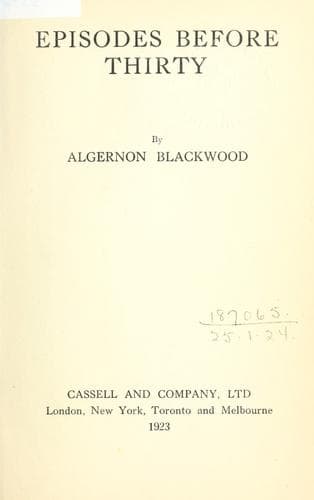
Authors, English -- 20th century -- Biography; Blackwood, Algernon, 1869-1951
Two incidents stand out still in the mind, one creditably pleasing to
vanity; the other, exactly the reverse. The latter, though it annoyed
Muldoon keenly at the moment, fortunately for me appealed to his sense
of humour too. He had given me an evening off--that is, all I had to do
was to write a brief report of a Students’ Concert in which his little
niece was performing.
“Without straining veracity,” he mentioned with a grin, “ye might
perhaps say something kind and pretty about her!” He winked, whispering
her name in my ear. “Have ye got it?” he asked fiercely. I nodded. Was
I thinking of something else at the moment? Was my mind in the woods
that lovely evening in spring?
At the concert I picked out the name I remembered and wrote later a
sturdy eulogistic notice of an atrocious performer, saying the very
prettiest and nicest things I could think of, then went home to a
coveted early bed. But Muldoon’s grim smile next day, as I reported at
his desk for an assignment, gave me warning that something was wrong.
He did not keep me in suspense. I had selected for my praise, not
only the crudest performer of the concert--that I already knew--but
one whom all the other pupils disliked intensely, and whose name they
particularly hoped would be omitted altogether. The niece I had not
even mentioned.
The other incident that stands out after all these years was more
creditable. Dr. Lyman Abbott, Editor of the _Outlook_, which once Henry
Ward Beecher edited as the _Church Union_, was preaching in Beecher’s
Plymouth Church, Brooklyn, a series of sermons on “The Theology of
an Evolutionist,” and Muldoon had persuaded the editor-in-chief that
a full report on the front page every Monday would be a credit to
the paper. His proposal was agreed to, apparently without too much
enthusiasm. The Irishman was determined to justify it. “I want ye to
take it on,” said Muldoon to me. “Ye can write shorthand. Make it 150.”
A column was 100. To have a column and a-half on the front page, if I
could do it well, would be a feather in my cap. But my shorthand was
poor, I was out of practice too, bad notes are impossible to read for
transcription, and mistakes would mean angry letters of correction from
Dr. Abbott, probably.
Monday was my day off. I went to Plymouth Church with a new notebook
and three soft lead pencils, duly sharpened at both ends. In the brief
interval before Sunday I practised hard. The church was packed to the
roof, as I sneaked up the aisle--an unfamiliar place, I felt it!--to a
little table placed immediately beneath the pulpit. I came in after the
service, but just in time for the sermon. There were no other reporters
present. It thrilled me to see Dr. Abbott, who, as a young man of
twenty-three, had heard Lincoln speak on slavery.
Public-domain text, read in full here on John Shaqi.
Reviews
Reviews
No reviews yet
Be the first to share your thoughts on this work.
Elsewhere in the archive
Join the Discussion
Join the discussion
Sign in to leave a comment or review.
Sign InorCreate an account