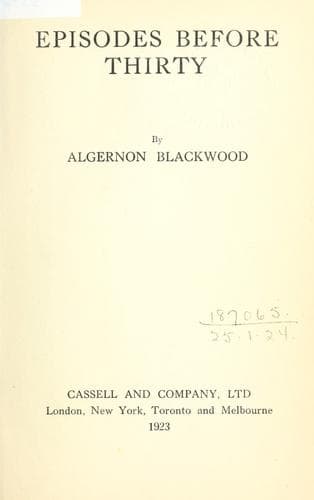
Authors, English -- 20th century -- Biography; Blackwood, Algernon, 1869-1951
It is difficult to put into intelligible, convincing words the
irresistible character of this Nature-spell that invades heart and
brain like a drenching sea, and produces a sense of rapture, of
ecstasy, compared to which the highest conceivable worldly joy becomes
merely insipid.... Heat from this magical source was always more or
less present in my mind from a very early age, though, of course, no
attempt to analyse or explain it was then possible; but, in bitter
years to come, the joy and comfort Nature gave became a real and only
solace. When possession was at its full height, the ordinary world,
and my particular little troubles with it, fell away like so much
dust; the whole fabric of men and women, commerce and politics, even
the destinies of nations, became a passing show of shadows, while the
visible and tangible world showed itself as but a temporary and limited
representation of a real world elsewhere whose threshold I had for a
moment touched.
Others, of course, have known similar experiences, but, being
better equipped, have understood how to correlate them to ordinary
life. Richard Jefferies explained them. Whitman tasted expansion of
consciousness in many ways; Fechner made a grandiose system of them;
Edward Carpenter deliberately welcomed them; Jacob Boehme, Plotinus,
and many others have tried to fix their nature and essence in terms,
respectively, of religion and philosophy; and William James has
reviewed them with an insight as though he had had experienced them
himself. Whatever their value, they remain authentic, the sense of
oneness of life their common denominator, a conviction of consciousness
pervading all forms everywhere their inseparable characteristic.
If Kentish gardens saw the birth of this delight, the Black Forest
offered further opportunities for its enjoyment, and a year in a
village of the Swiss Jura Mountains to learn French--I often wandered
all night in the big pine forests without my tutor, a bee-keeping
pasteur, at Bôle, near Neuchâtel, discovering my absence--intensified
it. Without it something starved in me. It was a persistent craving,
often a wasting _nostalgia_, that cried for satisfaction as the whole
body cries for covering when cold, and Nature provided a companionship,
a joy, a bliss, that no human intercourse has ever approached, much
less equalled. It remains the keenest, deepest sensation of its kind I
have known....
Public-domain text, read in full here on John Shaqi.
Reviews
Reviews
No reviews yet
Be the first to share your thoughts on this work.
Join the Discussion
Join the discussion
Sign in to leave a comment or review.
Sign InorCreate an account