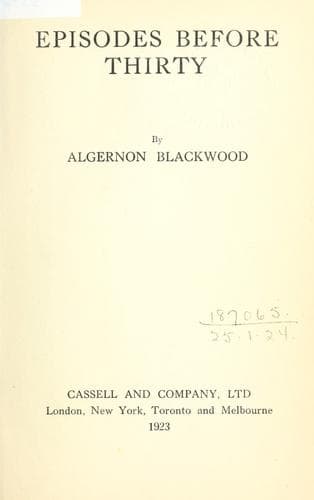
Authors, English -- 20th century -- Biography; Blackwood, Algernon, 1869-1951
That sour milk became a veritable nightmare that never left me. I had
enough of milk. Yet, later in life, I found myself “in milk” again,
but that time it was dried milk, a profitable business to the owners,
though it brought me nothing. I worked six years at it for a bare
living wage. But, at any rate, it couldn’t turn sour. It was a powder.
Alfred Cooper was a delightful fellow. I think some detail of how our
partnership came to be may bear the telling. It points a moral if it
does not adorn a tale. It may, again, prove useful to other young
Englishmen in Canada similarly waiting with money to invest; but on the
other hand it may not, since there can be few, I imagine, as green as
I was then, owing to a strange upbringing, or as ignorant of even the
simplest worldly practices. Of the evangelical training responsible for
this criminal ignorance I will speak later.
Cooper, then, was a delightful fellow, fitting my ideal of a type I
had read about--the fearless, iron-muscled colonial white man who
fought Indians. The way we met was quite simply calculated--by a clerk
in the bank where my English allowance of £100 a year was paid by my
father. The clerk and I made friends--naturally; and one day--also
naturally--he suggested a Sunday walk to Islington, some six miles
down the lake shore. We could get tea at a farm he knew. We did. The
praises of the Cooper family, who owned it, had already been sung. I
was enchanted. So, doubtless, was the clerk.
The farm was a small one--perhaps eight acres; and Cooper lived on it
in poverty with his aged mother and unmarried sister. It was charmingly
situated, the fields running down to the water, pine copses dotting
the meadows to the north, and the little village church standing at
one corner near the road. Mrs. Cooper, in cap and apron, dropping
every “h” that came her way, described to me how she and her husband
had emigrated from England sixty years before, in the days of sailing
ships. Her husband’s grave in the churchyard we could see from
the window while we sat at tea--an unusually sumptuous tea for a
farmhouse--and it was evident that she was more alive to the memories
of half a century ago in the “old country,” than to the plans of her
ambitious son in the new colony.
Public-domain text, read in full here on John Shaqi.
Reviews
Reviews
No reviews yet
Be the first to share your thoughts on this work.
Join the Discussion
Join the discussion
Sign in to leave a comment or review.
Sign InorCreate an account