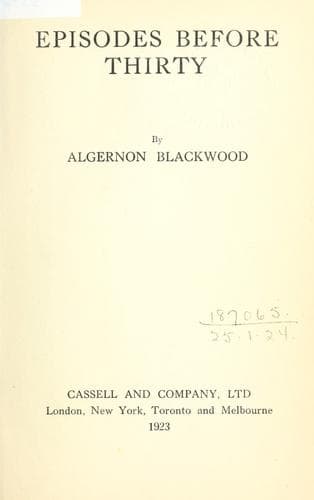
Authors, English -- 20th century -- Biography; Blackwood, Algernon, 1869-1951
Next day there was a racing west wind that sent the clouds scudding
across a bright blue sky. The doctor was to come at 3 o’clock. Boyde,
in very optimistic mood, had gone out early, taking my letter to
McCloy. He had a studio sitting; he was going to Patterson too; he
would return as early as he could. The shadow of the night before
had vanished; I no longer believed in it; I ascribed it to fever and
nerves. He sang cheerily while he dressed in my thick brown suit, the
only one not in pawn (everything else, now that I was in bed, had gone
to Ikey), and his voice sounded delightful. In the afternoon he came
back with the news that McCloy had read my letter and said “That’s
right. Tell him to be good to himself. He can come back.” Also he had
agreed to use translations of the French stories at five dollars each.
Boyde brought a _Courier_ in with him. Two letters from home arrived
too. Both my father and mother, though having no idea what was going
on, never missed a single week. My own letters were difficult to write.
I had come to New York against my father’s advice. I wrote home what I
thought best.
At 3 o’clock the doctor came. My heart sank as I heard his step. I
was in considerable pain. What would he be like? Would an operation
be necessary? Would he speak about money again? Mrs. Bernstein, oily
and respectful, a little awed as well, announced him. Without a
word, without a glance in my direction, he walked over in his slow,
deliberate way, and laid hat and bag upon the sofa. Then he turned and
looked steadily at himself in the mirror for a period I thought would
never end. After that he turned and looked at me.
He was an angel. His face was wreathed in smiles. It beamed with
good-nature, kindness, sympathy. He at once said something that was
gentle, soothing, like music to me. My heart suddenly expanded in a
most uncomfortable way. I believe a lump came up in my throat. This
was all so contrary to what I had expected. He was not only an angel,
he was a womanly angel. I must have been in a very weak state, for it
was all I could do to keep my tears back. The same instant his eye fell
on my fiddle case. He looked at it, then at me, then back again at the
fiddle.
“You play?” he asked, with a twinkle in his big eyes.
“I ought to pawn it,” I said, “but----”
Public-domain text, read in full here on John Shaqi.
Reviews
Reviews
No reviews yet
Be the first to share your thoughts on this work.
Elsewhere in the archive
Join the Discussion
Join the discussion
Sign in to leave a comment or review.
Sign InorCreate an account