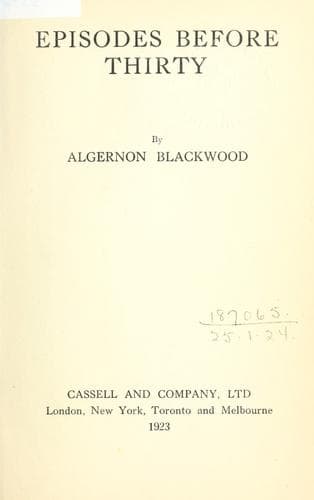
Authors, English -- 20th century -- Biography; Blackwood, Algernon, 1869-1951
“Don’t,” he answered with decision. He added an odd sentence: “It’s
an esgape from self.” I remember that I couldn’t say a word to this.
His kindness melted me. The struggle to keep my eyes from betraying
me seemed the most idiotic yet bitter I had ever known. I could have
kissed the old man’s hand, when he examined me then at once, but with
a gentleness, even a tenderness, that both astonished me, yet did not
astonish me at all. I felt, too, already the support of his mind and
character, of his whole personality, of a rugged power in him, of
generosity, true goodness, above all, of sympathy. I think he had made
up his mind to treat me for nothing. No reference, in any case, was
made to money; nor did I dare even to mention it myself. An operation,
moreover, of any big kind, was not necessary; he thought he could save
me that; he performed a small one then and there, for he had brought
all that was required for it. The pain seemed nothing, his kindness
made me indifferent to it. “You are brave,” he said, with a smile that
seemed to me really beautiful, when it was over. “That hurt, I know.”
He promised to come daily to drain the wound and so forth; he bandaged
me up; a month to six weeks would see me out of bed, he hoped; he
packed up his bag, but, instead of leaving the room, he then sat down
deliberately and began to talk.
I was too surprised, too happy, to wonder why he stayed. His talk
was food and drink to me. He picked up my few books, and sat reading
quietly to himself when he saw I was getting tired. De Quincey’s
“Confessions” interested him especially, and he asked if he might
borrow it. He took also “Sartor Resartus.” I slipped into German, to
his keen delight, and told him about the Moravian Brotherhood School
in the Black Forest. A sketch of the recent past I gave him too. He
listened with great attention, asking occasional questions, but always
with real tact, and never allowing me to tire myself.
Though it was obvious, even to my stupidity, that he regarded me rather
as a “specimen” of some sort, there was heart in all he said and did.
Otto Huebner poured balm into all my little wounds that afternoon, but
about himself he told me hardly anything. While he drew me out, with
skill and sympathy, he hid himself behind that impenetrable mystery I
had already noted the previous day. I say purposely that of himself
he told me “hardly anything,” because one detail did escape him
inadvertently. An hour later, as he was leaving, he turned his smile
on me from the door. “I send you something,” he said shortly. “My vife
makes goot broth. I cannot do much. I have not got it.”
Public-domain text, read in full here on John Shaqi.
Reviews
Reviews
No reviews yet
Be the first to share your thoughts on this work.
Elsewhere in the archive
Join the Discussion
Join the discussion
Sign in to leave a comment or review.
Sign InorCreate an account