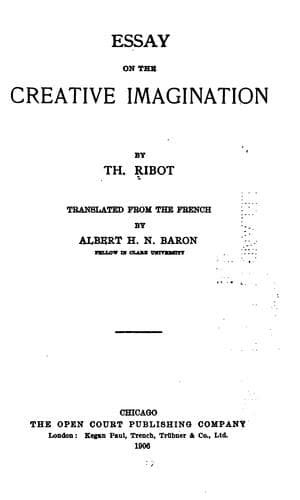
Essay on the Creative ImaginationRibot, Th. (Théodule)
Science
Essay on the Creative Imagination
Ribot, Th. (Théodule)
Creation (Literary, artistic, etc.); Imagination
We might generalize the question and ask whether or no there exists a
natural antagonism between true musical imagination and plastic
imagination. An answer in the affirmative seems scarcely liable to be
challenged. I had undertaken an investigation which, at the outset, made
for a different goal. It happens that it answered clearly enough the
question propounded above: the conclusion has arisen of itself,
unsought; which fact saves me from any charge of a preconceived opinion.
The question asked orally of a large number of people was this: "Does
hearing or even remembering a bit of _symphonic_ music excite visual
images in you and of what kind are they?" For self evident reasons
dramatic music was expressly excluded: the appearance of the theater,
stage, and scenery impose on the observer visual perceptions that have a
tendency to be repeated later in the form of memories.
The result of observation and of the collected answers are summed up as
follows:
Those who possess great musical culture and--this is by far more
important--taste or passion for music, generally have no visual images.
If these arise, it is only momentarily, and by chance. I give a few of
the answers: "I see absolutely nothing; I am occupied altogether with
the pleasure of the music: I live entirely in a world of sound. In
accordance with my knowledge of harmony, I analyze the harmonies but
not for long. I follow the development of the phrasing." "I see nothing:
I am given up wholly to my impressions. I believe that the chief effect
of music is to heighten in everyone the predominating feelings."
Those who possess little musical culture, and especially those having
little taste for music, have very clear visual representations. It must
nevertheless be admitted that it is very hard to investigate these
people. Because of their anti-musical natures, they avoid concerts, or
at the most, resign themselves to sit through an opera. However, since
the nature and quality of the music does not matter here, we may quote:
"Hearing a Barbary organ in the street, I picture the instrument to
myself. I see the man turning the crank. If military music sounds from
afar, I _see_ a regiment marching." An excellent pianist plays for a
friend Beethoven's sonata in C sharp minor, putting into its execution
all the pathos of which he is capable. The other sees in it "the tumult
and excitement of a fair." Here the musical rendering is misinterpreted
through misapprehension. I have several times noted this--in people
familiar with design or painting, music calls up pictures and various
scenes; one of these persons says that he is "besieged by visual
images." Here the hearing of music evidently acts as excitant.[98]
Public-domain text, read in full here on John Shaqi.
Reviews
Reviews
No reviews yet
Be the first to share your thoughts on this work.
Elsewhere in the archive
Join the Discussion
Join the discussion
Sign in to leave a comment or review.
Sign InorCreate an account