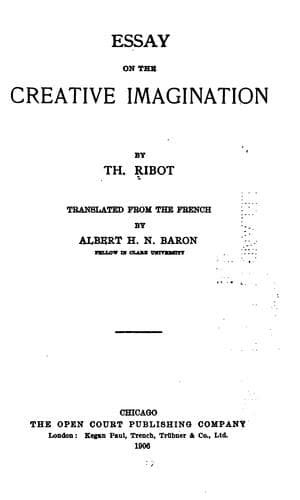
Essay on the Creative ImaginationRibot, Th. (Théodule)
Science
Essay on the Creative Imagination
Ribot, Th. (Théodule)
Creation (Literary, artistic, etc.); Imagination
In a word, insofar as it is permissible in psychology to make use of
general formulas--and with the proviso that they apply to most, not to
all cases--we may say that during the working of the musical imagination
the appearance of visual images is the exception; that when this form of
imagination is weak, the appearance of images is the rule.
Furthermore, this result of observation is altogether in accord with
logic. There is an irreducible antithesis between affective imagination,
the characteristic of which is interiority, and visual imagination,
basically objective. Intellectual language--speech--is an arrangement
of words that stand for objects, qualities, relations, extracts of
things: in order to be understood they must call up in consciousness the
corresponding images. Emotional language--music--is an appropriate
ordering of successive or simultaneous sounds, of melodies and harmonies
that are signs of affective states: in order to be understood, they must
call up in consciousness the corresponding affective modifications. But,
in the non-musically inclined, the evocative power is small--sonorous
combinations excite only superficial and unstable internal states. The
exterior excitation, that of the sounds, follows the line of least
resistance, and acting according to the psychic nature of the
individual, tends to arouse objective images, pictures, visual
representations, well or ill adapted.
To sum up: In contrast to sensorial imagination, which has its origin
without, affective imagination begins within. The _stuff_ of its
creation is found in the mental states enumerated above, and in their
innumerable combinations, which it expresses and fixes in language
peculiar to itself, of which it has been able to make wonderful use.
Taking it altogether, the only great division possible between the
different types of imagination is perhaps reducible to this: To speak
more exactly, there are exterior and interior imaginations. These two
chapters have given a sketch of them. There now remains for us to study
the less general forms of the creative power.
FOOTNOTES:
[86] See Appendix E.
[87] Let us cite merely the case of Balzac who, says one of his
biographers, "was always odd." He buys a property, in order to start
a dairy there with "the best cows in the world," from which he
expects to receive a net income of 3,000 francs. In addition,
high-grade vegetable gardens, same income; vineyard, with Malaga
plants, which should bring about 2,000 fr. He has the commune of
Sevres deed over to him a walnut tree, worth annually 2,000 francs
to him, because all the townspeople dump their rubbish there. And so
on, until at the end of four years he sees himself obliged to sell
his domain for 3,000 francs, after spending on it thrice that sum.
[88] Usener, _Goetternamen_, 1896.
[89] _Nouveaux Essais de critique_, p. 320.
[90] Or, as it has been expressed, "human qualities raised to their
highest power." (Tr.)
Public-domain text, read in full here on John Shaqi.
Reviews
Reviews
No reviews yet
Be the first to share your thoughts on this work.
Elsewhere in the archive
Join the Discussion
Join the discussion
Sign in to leave a comment or review.
Sign InorCreate an account