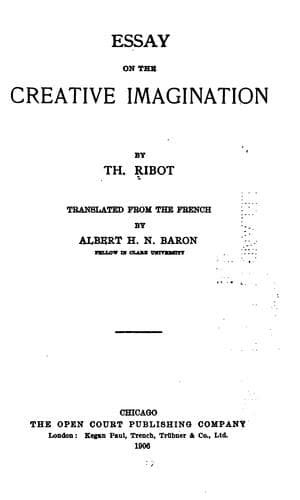
Essay on the Creative ImaginationRibot, Th. (Théodule)
Science
Essay on the Creative Imagination
Ribot, Th. (Théodule)
Creation (Literary, artistic, etc.); Imagination
[91] The same statement holds good as regards the "Temptations of
Saint Anthony" and other analogous subjects that have often
attracted painters.
[92] R. Dubois, _Lecons de physiologie generale et comparee_, p.
286.
[93] Von Baer, in James, _Psychology_, I, 639.
[94] _Psychology of the Emotions_, Part I, Chapter IX.
[95] Arreat, _Memoire et Imagination_, p. 118.
[96] Mendelssohn wrote to an author who composed verses for his
_Lieder_: "Music is more definite than speech, and to want to
explain it by means of words is to make the meaning obscure. I do
not think that words suffice for that end, and were I persuaded to
the contrary, I would not compose music. There are people who accuse
music of being ambiguous, who allege that words are always
understood: for me it is just the other way; words seem to me vague,
ambiguous, unintelligible, if we compare them to the true music that
fills the soul with a thousand things better than words. What the
music that I like expresses to me seems to me too _definite_, rather
than too indefinite, for anyone to be able to match words to it."
[97] Oelzelt-Newin, _op. cit._, pp. 22-23. For analogous facts from
contemporary musicians, see Paulhan, _Rev. Phil._, 1898, pp. 234-35.
[98] For the sake of brevity and clearness I do not give here the
observations and evidence. They will be found at the end of this
work, as Appendix D.
Under the title "An experimental test of musical expressiveness,"
Gilman, in _American Journal of Psychology_, vol. IV, No. 4, and vol.
V, No. 1 (1892-3), has studied from another point of view the effect
of music on various listeners. Eleven selections were given; I note
that three or four at the most excited visual images--ten (perhaps
eleven), emotional states. More recently, the _Psychological Review_
(September, 1898, pp. 463 ff.) has published a personal observation of
Macdougal in which sight-images accompany the hearing of music only
exceptionally and under special conditions. The author characterizes
himself as a "poor visualizer;" he declares that music arouses in him
only very rarely visual representations; "even then they are
fragmentary, consisting of simple forms without bond between them,
appearing on a dark background, remaining visible for a moment or two,
and soon disappearing." But, having gone to the concert fatigued and
jaded, he sees nothing during the first number: the visions begin
during the _andante_ of the second, and accompany "in profusion" the
rendering of the third. (See Appendix D.) May we not assume that the
state of fatigue, by lowering the vital tone, which is the basis of
the emotional life, likewise diminishes the tendency of affective
dispositions to arise again under the form of memory? On the other
hand, sensory images remain without opposition and come to the front;
at least, unless they are reenforced by a state of semi-morbid
excitation.
CHAPTER III.
THE MYSTIC IMAGINATION
Public-domain text, read in full here on John Shaqi.
Reviews
Reviews
No reviews yet
Be the first to share your thoughts on this work.
Elsewhere in the archive
Join the Discussion
Join the discussion
Sign in to leave a comment or review.
Sign InorCreate an account