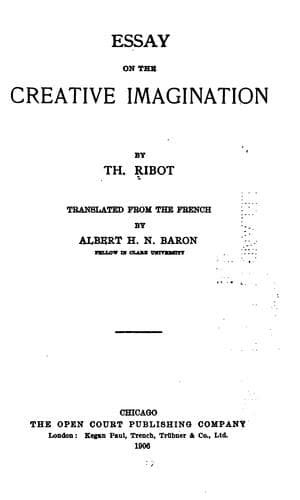
Essay on the Creative ImaginationRibot, Th. (Théodule)
Science
Essay on the Creative Imagination
Ribot, Th. (Théodule)
Creation (Literary, artistic, etc.); Imagination
(1) The all-embracing cosmological form is the conception of the world
by a purely imaginative being. It is rare, abnormal, and is nowadays met
with only in a few artists, dreamers, or morbidly esthetic persons, as a
kind of survival and temporary form. Thus, Victor Hugo sees in each
letter of the alphabet the pictured imitation of one of the objects
essential to human knowledge: "_A_ is the head, the gable, the
cross-beam, the arch, _arx_; _D_ is the back, _dos_; _E_ is the
basement, the console, etc., so that man's house and its architecture,
man's body and its structure, and then justice, music, the church, war,
harvesting, geometry, mountains, etc.--all that is comprised in the
alphabet through the mystic virtue of form."[104] Even more radical is
Gerard de Nerval (who, moreover, was frequently subject to
hallucinations): "At certain times everything takes on for me a new
aspect--secret voices come out of plant, tree, animals, from the
humblest insects, to caution and encourage me. Formless and lifeless
objects have mysterious turns the meaning of which I understand." To
others, contemporaries, "the real world is a fairy land."
The middle ages--a period of lively imagination and slight rational
culture--overflowed in this direction. "Many thought that on this earth
everything is a sign, a figure, and that the visible is worth nothing
except insofar as it covers up the invisible." Plants, animals--there is
nothing that does not become subject for interpretation; all the members
of the body are emblems; the head is Christ, the hairs are the saints,
the legs are the apostles, the eye is contemplation, etc. There are
extant special books in which all that is seriously explained. Who does
not know the symbolism of the cathedrals, and the vagaries to which it
has given rise? The towers are prayer, the columns the apostles, the
stones and the mortar the assembly of the faithful; the windows are the
organs of sense, the buttresses and abutments are the divine assistance;
and so on to the minutest detail.
In our day of intense intellectual development, it is not given to many
to return sincerely to a mental condition that recalls that of the
earliest times. Even if we come near it, we still find a difference.
Primitive man puts life, consciousness, activity, into everything;
symbolism does likewise, but it does not believe in an autonomous,
distinct, particular soul inherent in each thing. The absence of
abstraction and generalization, characteristic of humanity in its early
beginnings, when it peoples the world with myriads of animate beings,
has disappeared. Every source of activity revealed by symbols appears
as a fragmentary manifestation; it descends from a single primary,
personal or impersonal, spring. At the root of this imaginative
construction there is always either theism or pantheism.
Public-domain text, read in full here on John Shaqi.
Reviews
Reviews
No reviews yet
Be the first to share your thoughts on this work.
Elsewhere in the archive
Join the Discussion
Join the discussion
Sign in to leave a comment or review.
Sign InorCreate an account