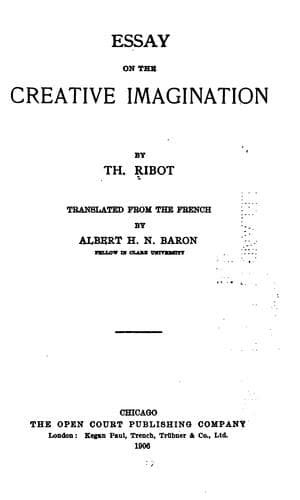
Essay on the Creative ImaginationRibot, Th. (Théodule)
Science
Essay on the Creative Imagination
Ribot, Th. (Théodule)
Creation (Literary, artistic, etc.); Imagination
(2) Mystical imagination has often and erroneously been identified with
religious imagination. Although it may be held that every religion, no
matter how dull and poor, presupposes a latent mysticism, because it
supposes an Unknown beyond the reach of sense, there are religions very
slightly mystical in fact--those of savages, strictly utilitarian; among
barbarians, the martial cults of the Germans and the Aztecs; among
civilized races, Rome and Greece.[105] However, even though the mystic
imagination is not confined to the bounds of religious thought, history
shows us that there it attains its completest expansion.
To be brief, and to keep strictly within our subject, let us note that
in the completely developed great religions there has arisen opposition
between the rationalists and the imaginative expounders, between the
dogmatists and the mystics. The former, rational architects, build by
means of abstract ideas, logical relations and methods, by deduction and
induction; the others, imaginative builders, care little for this
learned magnificence--they excel in vivid creations because the moving
energy with them is in their feelings, "in their hearts;" because they
speak a language made up of concrete images, and consequently their
wholly symbolic speech is at the same time an original construction. The
mystic imagination is a transformation of the mythic imagination, the
myth changing into symbols. It cannot escape the necessity of this. On
the other hand, the affective states cannot longer remain vague,
diffuse, purely internal; they must become fixed in time and space, and
condensed into images forming a personality, legend, event, or rite.
Thus, Buddha represents the tendencies towards pity and resignation,
summing up the aspirations for final rest. On the other hand, abstract
ideas, pure concepts, being repugnant to the mystic's nature, it is also
necessary that they take on images through which they may be seen--e.g.,
the relations between God and man, in the various forms of
communion; the idea of divine protection in incarnations, mediators,
etc. But the images made use of are not dry and colorless like words
that by long use have lost all direct representative value and are
merely marks or tags. Being symbolic, i.e., concrete, they are, as we
have seen, direct substitutes for reality, and they differ as much from
words as sketching and drawing differ from our alphabetical signs, which
are, however, their derivatives or abbreviations.
Public-domain text, read in full here on John Shaqi.
Reviews
Reviews
No reviews yet
Be the first to share your thoughts on this work.
Elsewhere in the archive
Join the Discussion
Join the discussion
Sign in to leave a comment or review.
Sign InorCreate an account