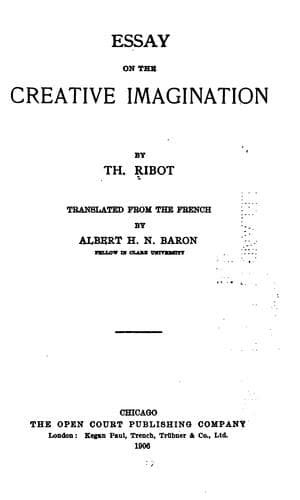
Essay on the Creative ImaginationRibot, Th. (Théodule)
Science
Essay on the Creative Imagination
Ribot, Th. (Théodule)
Creation (Literary, artistic, etc.); Imagination
In this imaginative plan of the world we may recognize stages according
to the increasing weakness of the systems, depending on the number and
quality of the hypotheses. For example, the progression is apparent
between Plotinus and the frenzied creations of the Gnostics and the
Cabalists. With the latter, we come into a world of unbridled fancy
which, in place of human romances, invents cosmic romances. Here appear
the allegorical beings mentioned above, half concept, half symbol; the
ten Sephiros of the Cabala, immutable forms of being; the _syzygies_ or
couples of Gnosticism--soul and reflection, depth and silence, reason
and life, inspiration and truth, etc.; the absolute manifesting itself
by the unfolding of fifty-two attributes, each unfolding comprising
seven _eons_, corresponding to the 364 days of the year, etc. It would
be wearisome to follow these extravagant thoughts, which, though the
learned may treat them with some respect, have for the psychologist only
the interest of pathologic evidence. Moreover, this form of mystic
imagination presents too little that is new for us to speak of it
without repeating ourselves.
To conclude: The mystic imagination, in its alluring freedom, its
variety, and its richness, is second to no form, not even to esthetic
invention, which, according to common prejudice, is the type _par
excellence_. Following the most venturesome methods of analogy, it has
constructed conceptions of the world made up almost wholly of feelings
and images--symbolic architectures.
FOOTNOTES:
[99] _Philosophy of the Unconscious_, I, part 2, ch. IX.
[100] J. Darmesteter, in Recejac, _Essai sur les fondements de la
connaissance mystique_, p. 124.
[101] In such notions may perhaps be best found the genesis of the
present superstitions in regard to "lucky" and "unlucky" numbers,
like the number 13, which have such persistence. (Tr.)
[102] See Part Two, chapter II.
[103] Groos, _Die Spiele der Thiere_, pp. 308-312.
[104] Mabilleau, _op. cit._, p. 132.
[105] If we leave out oriental influences and the Mysteries, which,
according to Aristotle, were not dogmatic teaching, but a show, an
assemblage of symbols, acting by evocation, or suggestion, following
the special mode of mystic imagination that we already know.
[106] Recejac, _op. cit._, pp. 139 ff.
[107] One at once calls to mind Plotinus, whose highest philosophy
is a kind of indescribable ecstacy. (Tr.)
[108] Hartmann, _op. cit._, vol. I, part 2, chapter IX.
CHAPTER IV
THE SCIENTIFIC IMAGINATION
Public-domain text, read in full here on John Shaqi.
Reviews
Reviews
No reviews yet
Be the first to share your thoughts on this work.
Elsewhere in the archive
Join the Discussion
Join the discussion
Sign in to leave a comment or review.
Sign InorCreate an account