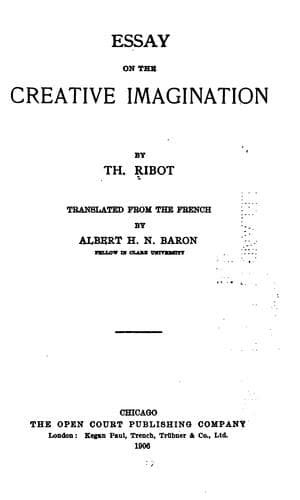
Essay on the Creative ImaginationRibot, Th. (Théodule)
Science
Essay on the Creative Imagination
Ribot, Th. (Théodule)
Creation (Literary, artistic, etc.); Imagination
It must, however, be noted that if "the mystic fact is a naive effort to
apprehend the absolute, a mode of symbolic, not dialectic, thinking,
that lives on symbols and finds in them the only fitting
expression,"[106] it seems that this imaginative phase has been to some
minds only an internal form, for they have attempted to go beyond it
through ecstacy, aspiring to grasp the ultimate principle as a pure
unity, without image and without form,[107] which metaphysical realism
hopes to attain by other methods and by a different route. However
interesting they may be for psychology, these attempts, luring one on
further and further, by their seeming or real elimination of every
symbolic element, become foreign to our subject, and we cannot consider
them at greater length here.
(3) "History shows that philosophy has done nothing but transform ideas
of mystic production, substituting for the form of images and
undemonstrated statements the form of assertions of a rational
system."[108] This declaration of a metaphysician saves us from dwelling
on the subject long.
When we seek the difference between religious and metaphysical or
philosophical symbolism, we find it in the nature of the constitutive
elements. Turned in the direction of religion, mystic symbolism
presupposes two principal elements--imagination and feeling; turned in
a metaphysical direction, it presupposes imagination and a very small
rational element. This substitution involves appreciable deviation
from the primitive type. The construction is of greater logical
regularity. Besides, and this is the important characteristic, the
subject-matter--though still resembling symbolic images--tends to
become concepts: such are vivified abstractions, allegorical beings,
hereditary entities of spirits and of gods. In short, metaphysical
mysticism is a transition-form towards metaphysical rationalism,
although these two tendencies have always been inimical in the history
of philosophy, just as in the history of religion.
Public-domain text, read in full here on John Shaqi.
Reviews
Reviews
No reviews yet
Be the first to share your thoughts on this work.
Elsewhere in the archive
Join the Discussion
Join the discussion
Sign in to leave a comment or review.
Sign InorCreate an account