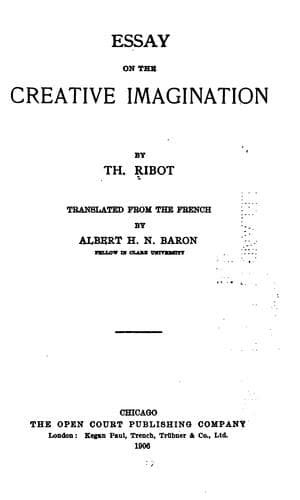
Essay on the Creative ImaginationRibot, Th. (Théodule)
Science
Essay on the Creative Imagination
Ribot, Th. (Théodule)
Creation (Literary, artistic, etc.); Imagination
(2) The semi-sciences, incompletely proved (certain portions of
biology, psychology, sociology, etc.), although they show a regression
of imaginative explanation repulsed by the hitherto absent or
insufficient experimentation, nevertheless abound in hypotheses, that
succeed, contradict, destroy one another. It is a commonplace truism
that does not need to be dwelt on--they furnish _ad libitum_ examples of
what has been rightly termed scientific mythology.
Aside from the quantity of imagination expended, often without great
profit, there is another character to be noted--the nature of the belief
that accompanies imaginative creation. We have already seen repeatedly
that the intensity of the imaginary conception is in direct ratio to the
accompanying belief, or rather, that the two phenomena are really
one--merely the two aspects of one and the same state of consciousness.
But faith--i.e., the adherence of the mind to an undemonstrated
assertion--is here at its maximum.
There are in the sciences hypotheses that are not believed in, that are
preserved for their didactic usefulness, because they furnish a simple
and convenient method of explanation. Thus the "properties of matter"
(heat, electricity, magnetism, etc.), regarded by physicists as distinct
qualities even in the first half of the last century; the "two electric
fluids;" cohesion, affinity, etc., in chemistry--these are some of the
convenient and admitted expressions to which, however, we attach no
explanatory value.
There is also to be mentioned the hypothesis held as an approximation
of reality--this is the truly scientific position. It is accompanied by
a provisional and ever-revocable belief. This is admitted, in principle
at least, by all scientists, and has been put into practice by many of
them.
Lastly, there is the hypothesis regarded as the truth itself--one that
is accompanied by a complete, absolute, belief. But daily observation
and history show us that in the realm of embryonic and ill-proven
sciences this disposition is more flourishing than anywhere else. _The
less proof there is, the more we believe._ This attitude, however wrong
from the standpoint of the logician, seems to the psychologist natural.
The mind clings tenaciously to the hypothesis because the latter is its
own creation, or, because in adopting it, it seems to the mind that it
should have itself discovered the hypothesis, so much does the latter
harmonize with its inner states. Let us take the hypothesis of
evolution, for example: we need not mention its high philosophical
bearing, and the immense influence that it exerts on almost all forms of
human thought. Nevertheless, it still remains an hypothesis; but for
many it is an indisputable and inviolable dogma, raised far above all
controversy. They accept it with the uncompromising fervor of believers:
a new proof of the underlying connection between imagination and
belief--they increase and decrease _pari passu_.
III
Public-domain text, read in full here on John Shaqi.
Reviews
Reviews
No reviews yet
Be the first to share your thoughts on this work.
Elsewhere in the archive
Join the Discussion
Join the discussion
Sign in to leave a comment or review.
Sign InorCreate an account