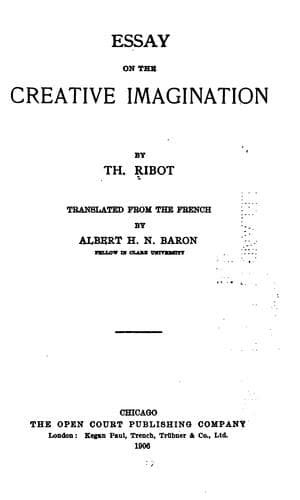
Essay on the Creative ImaginationRibot, Th. (Théodule)
Science
Essay on the Creative Imagination
Ribot, Th. (Théodule)
Creation (Literary, artistic, etc.); Imagination
Should we assign as belonging solely to the imagination every invention
or discovery--in a word, whatever is new--in the well-organized sciences
that form a body of solid, constantly-broadening doctrine? It is a hard
question. That which raises scientific knowledge above popular knowledge
is the use of an experimental method and rigorous reasoning processes;
but, is not induction and deduction going from the known to the unknown?
Without desiring to depreciate the method and its value, it must
nevertheless be admitted that it is preventive, not inventive. It
resembles, says Condillac, the parapets of a bridge, which do not help
the traveler to walk, but keep him from falling over. It is of value
especially as a habit of mind. People have wisely discoursed on the
"methods" of invention. There are none; but for which fact we could
manufacture inventors just as we make mechanics and watchmakers. It is
the imagination that invents, that provides the rational faculties with
their materials, with the position, and even the solution of their
problems. Reasoning is only a means for control and proof; it transforms
the work of the imagination into acceptable, logical results. If one has
not imagined beforehand, the logical method is aimless and useless, for
we cannot reason concerning the completely unknown. Even when a problem
seems to advance towards solution wholly through the reason, the
imagination ceaselessly intervenes in the form of a succession of
groupings, trials, guesses, and possibilities that it proposes. The
function of method is to determine its value, to accept or reject
it.[111]
Let us show by a few examples that conjecture, the work of the combining
imagination, is at the root of the most diverse scientific
inventions.[112]
Every mathematical invention is at first only an hypothesis that must be
demonstrated, i.e., must be brought under previously established
general principles: prior to the decisive moment of rational
verification it is only a thing imagined. "In a conversation concerning
the place of imagination in scientific work," says Liebig, "a great
French mathematician expressed the opinion to me that the greater part
of mathematical truth is acquired not through deduction, but through the
imagination. He might have said 'all the mathematical truths,' without
being wrong." We know that Pascal discovered the thirty-second
proposition of Euclid all by himself. It is true that it has been
concluded, wrongly perhaps, that he had also discovered all the earlier
ones, the order followed by the Greek geometrician not being necessary,
and not excluding other arrangements. However it be, reasoning alone was
not enough for that discovery. "Many people," says Naville, "of whom I
am one, might have thought hard all their lives without finding out the
thirty-two propositions of Euclid." This fact alone shows clearly the
difference between invention and demonstration, imagination and reason.
Public-domain text, read in full here on John Shaqi.
Reviews
Reviews
No reviews yet
Be the first to share your thoughts on this work.
Elsewhere in the archive
Join the Discussion
Join the discussion
Sign in to leave a comment or review.
Sign InorCreate an account