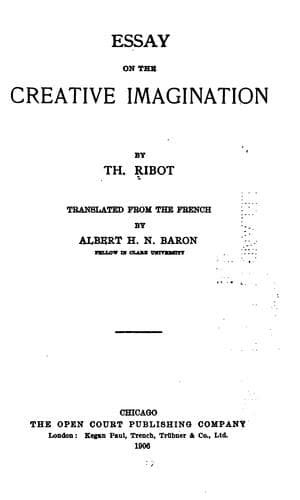
Essay on the Creative ImaginationRibot, Th. (Théodule)
Science
Essay on the Creative Imagination
Ribot, Th. (Théodule)
Creation (Literary, artistic, etc.); Imagination
(I) There is first of all, at least in great inventors, an inborn
quality,--that is, a natural disposition,--that does not originate in
experience and owes the latter only its development. This quality is a
bent in a practical, useful direction; a tendency to act, not in the
realm of dreams or human feeling, not on individuals or social groups,
not toward the attainment of theoretical knowledge of nature, but to
become master over natural forces, to transform them and adapt them
toward an end.
Every mechanical invention arises from a need: from the strict necessity
for individual preservation in the case of primitive man who wages war
against the powers of nature; from the desire for well-being and the
necessity for luxury in growing civilization; from the need of creating
little engines, imitating instruments and machines, in the child. In a
word, _every particular invention, great or small, arises from a
particular need_; for, we repeat again, there is no creative instinct in
general. A man distinguished for various inventions along practical
lines, writes: "As far as my memory allows, I can state that in my case
conception always results from a material or mental need.[124] It
springs up suddenly. Thus, in 1887, a speech of Bismarck made me so
angry that I immediately thought of arming my country with a repeating
rifle. I had already made various applications to the ministry of war,
when I learned that the Lebel system had just been adopted. My
patriotism was fully satisfied, but I still have the design of the gun
that I invented." This communication mentions two or three other
inventions that arose under analogous circumstances, but have had a
chance of being adopted.
Among the requisite qualities I mention the natural and necessary
preeminence of certain groups of sensations or images (visual, tactile,
motor) that may be decisive in determining the direction of the
inventor.
(II) Mechanical invention grows by successive stratifications and
additions, as in the sciences, but more completely. It is a fine
verification of the "subsidiary law of growing complexity" previously
discussed.[125] If we measure the distance traversed since the distant
ages when man was naked and unarmed before nature to the present time of
the reign of machinery, we are astonished at the amount of imagination
produced and expended, often uselessly lavished, and we ask ourselves
how such a work could have been misunderstood or so lightly appreciated.
It does not pertain to our subject to make even a summary table of this
long development. The reader can consult the special works which,
unfortunately, are most often fragmentary and lack a general view. So we
should feel grateful to a historian of the useful arts, L. Bourdeau,
for having attempted to separate out the philosophy of the subject, and
for having fastened it down in the following formulas:[126]
(a) The exploitation of the powers of nature is made according to their
degree of power.
Public-domain text, read in full here on John Shaqi.
Reviews
Reviews
No reviews yet
Be the first to share your thoughts on this work.
Elsewhere in the archive
Join the Discussion
Join the discussion
Sign in to leave a comment or review.
Sign InorCreate an account