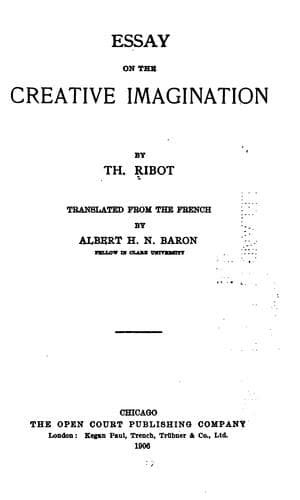
Essay on the Creative ImaginationRibot, Th. (Théodule)
Science
Essay on the Creative Imagination
Ribot, Th. (Théodule)
Creation (Literary, artistic, etc.); Imagination
(b) The extension of working instruments has followed a logical
evolution in the direction of growing complexity and perfection.
Man, according to the observations of M. Bourdeau, has applied his
creative activity to natural forces and has set them to work according
to a regular order, viz.:
(1) Human forces, the only ones available during the "state of nature"
and the savage state. Before all else, man created weapons: the most
circumscribed primitive races have invented engines for attack and
defense--of wood, bone, stone, as they were able. Then the weapon became
a tool by special adaptation:--the battle-club serves as a lever, the
tomahawk as a hammer, the flint ax as a hatchet, etc. In this manner
there is gradually formed an arsenal of instruments. "Inferior to most
animals as regards certain work that would have to be done with the aid
of our organic resources alone, we are superior to all as soon as we set
our tools at work. If the rodents with their sharp teeth cut wood better
than we can, we do it still better with the ax, the chisel, the saw.
Some birds, with the help of a strong beak, by repeated blows,
penetrate the trunk of a tree: but the auger, the gimlet, the wimble do
the same work better and more quickly. The knife is superior to the
carnivore's teeth for tearing meat; the hoe better than the mole's paw
for digging earth, the trowel than the beaver's tail for beating and
spreading mortar. The oar permits us to rival the fish's fin; the sail,
the wing of the bird. The distaff and spindle allow our imitating the
industry of insect spinners; etc. Man thus reproduces and sums up in his
technical contrivances the scattered perfections of the animal world. He
even succeeds in surpassing them, because, in the form of tools, he uses
substances and combinations of effects that cannot figure as part of an
organism."[127] It is scarcely likely that most of these inventions
arose from a voluntary imitation of animals: but even supposing such an
origin, there would still remain a fine place for personal creative
work. Man has produced by conscious effort what life realizes by methods
that escape us; so that the creative imagination in man is a
_succedaneum_ of the generative powers of nature.
(2) During the pastoral stage man brought animals under subjection and
discipline. An animal is a machine, ready-made, that needs only to be
trained to obedience; but this training has required and stimulated all
sorts of inventions, from the harness with which to equip it, to the
chariots, wagons, and roads with which and on which it moves.
(3) Later, the natural motors--air and water--have furnished new
material for human ingenuity, e.g., in navigation; wind- and
water-mills, used at first to grind grain, then for a multitude of
uses--sawing, milling, lifting hammers; etc.
Public-domain text, read in full here on John Shaqi.
Reviews
Reviews
No reviews yet
Be the first to share your thoughts on this work.
Elsewhere in the archive
Join the Discussion
Join the discussion
Sign in to leave a comment or review.
Sign InorCreate an account