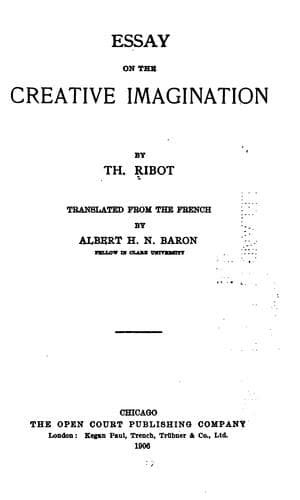
Essay on the Creative ImaginationRibot, Th. (Théodule)
Science
Essay on the Creative Imagination
Ribot, Th. (Théodule)
Creation (Literary, artistic, etc.); Imagination
(III) More than any other form, mechanical imagination depends strictly
on physical conditions. It cannot rest content with combining images, it
postulates material factors that impose themselves unyieldingly.
Compared to it, the scientific imagination has much more freedom in the
building of its hypotheses. In general, every great invention has been
preceded by a period of abortive attempts. History shows that the
so-called "initial moment" of a mechanical discovery, followed by its
improvements, is the moment ending a series of unsuccessful trials: we
thus skip a phase of pure imagination, of imaginative construction that
has not been able to enter into the mold of an appropriate determinism.
There must have existed innumerable inventions that we might term
mechanical romances, which, however, we cannot refer to because they
have left us no trace, not being born viable. Others are known as
curiosities because they have blazed the path. We know that Otto de
Guericke made four fruitless attempts before discovering his air-pump.
The brothers Montgolfier were possessed with the desire to make
"imitation clouds," like those they saw moving over the Alps. "In order
to imitate nature," they at first enclosed water-vapor in a light, stout
case, which fell on cooling. Then they tried hydrogen; then the
production of a gas with electrical properties; and so on. Thus, after a
succession of hypotheses and failures, they finally succeeded. From the
end of the sixteenth century there was offered the possibility of
communicating at a distance by means of electricity. "In a work
published in 1624 the Jesuit, Father Leurechon, described an imaginary
apparatus (by means of which, he said, people could converse at a
distance) for the aid of lovers who, by the connection of their
movements, would cause a needle to move about a dial on which would be
written the letters of the alphabet; and the drawing accompanying the
text is almost a picture of Breguet's telegraph." But the author
considered it impossible "in the absence of lovers having such
ability."[128]
Mechanical inventions that fail correspond to erroneous or unverified
scientific hypotheses. They do not emerge from the stage of pure
imagination, but they are instructive to the psychologist because they
give in bare form the initial work of the constructive imagination in
the technical field.
Public-domain text, read in full here on John Shaqi.
Reviews
Reviews
No reviews yet
Be the first to share your thoughts on this work.
Elsewhere in the archive
Join the Discussion
Join the discussion
Sign in to leave a comment or review.
Sign InorCreate an account