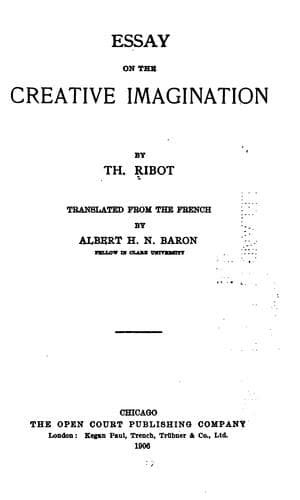
Essay on the Creative ImaginationRibot, Th. (Théodule)
Science
Essay on the Creative Imagination
Ribot, Th. (Théodule)
Creation (Literary, artistic, etc.); Imagination
There still remain the requirements of reasoning, of calculation, of
adaptation to the properties of matter. But, we repeat, this determinism
has several possible forms--one can reach the same goal through
different means. Besides, these determining conditions are not lacking
in any type of imagination; there is only a difference as between lesser
and greater. Every imaginative construction from the moment that it is
little more than a group of fancies, a spectral image haunting a
dreamer's brain, must take on a body, submit to external conditions on
which it depends, and which materialize it somewhat. In this respect,
architecture is an excellent example. It is classed among the fine arts;
but it is subject to so many limitations that its process of invention
strongly resembles technical and mechanical creations. Thus it has been
possible to say that "Architecture is the least personal of all the
arts." "Before being an art it is an industry in the sense that it has
nearly always a useful end that is imposed on it and rules its
manifestations. Whatever it builds--a temple, a theater, a palace--it
must before all else subordinate its work to the end assigned to it in
advance. This is not all:--it must take account of materials, climate,
soil, location, habits--of all things that may require much skill, tact,
calculation, which, however, do not interest art as such, and do not
permit architecture to manifest its purely esthetic qualities."[129]
Thus, at bottom, there is an identity of nature between the constructive
imagination of the mechanic and that of the artist: the difference is
only in the end, the means, and the conditions. The formula, _Ars homo
additus naturae_, has been too often restricted to esthetics--it should
comprehend everything artificial. Esthetes, doubtless, hold that their
imagination has for them a loftier quality--a disputed question that
psychology need not discuss; for it, the essential mechanism is the same
in the two cases: a great mechanic is a poet in his own way, because he
makes instruments imitating life. "Those constructions that at other
times are the marvel of the ignorant crowd deserve the admiration of the
reflecting:--Something of the power that has organized matter seems to
have passed into combinations in which nature is imitated or surpassed.
Our machines, so varied in form and in function, are the representatives
of a new kingdom intermediate between senseless and animate forms,
having the passivity of the former and the activity of the latter, and
exploiting everything for our sake. They are counterfeits of animate
beings, capable of giving inert substances a regular functioning. Their
skeleton of iron, organs of steel, muscles of leather, soul of fire,
panting or smoking breath, rhythm of movement--sometimes even the shrill
or plaintive cries expressing effort or simulating pain:--all that
contributes to give them a fantastic likeness to life--a specter and
dream of inorganic life."[130]
Public-domain text, read in full here on John Shaqi.
Reviews
Reviews
No reviews yet
Be the first to share your thoughts on this work.
Elsewhere in the archive
Join the Discussion
Join the discussion
Sign in to leave a comment or review.
Sign InorCreate an account