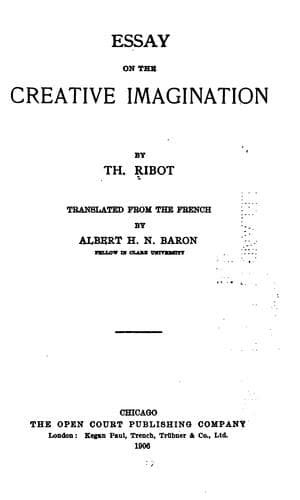
Essay on the Creative ImaginationRibot, Th. (Théodule)
Science
Essay on the Creative Imagination
Ribot, Th. (Théodule)
Creation (Literary, artistic, etc.); Imagination
Every intuition, then, becomes concrete as a judgment, equivalent to a
conclusion. But what seems obscure and even mysterious in it is the fact
that, from among many possible solutions, it finds at the first shot the
proper one. In my opinion this difficulty arises largely from a partial
comprehension of the problem. By "intuition" people mean only cases in
which the divination is correct; they forget the other, far more
numerous, cases that are failures. The act by which one reaches a
conclusion is a special case of it. What constitutes the originality of
the operation is not its accuracy, but its _rapidity_--the latter is the
essential character, the former accessory.
Further, it must be acknowledged that the gift of seeing correctly is an
inborn quality, vouchsafed to one, denied to another:--people are born
with it, just as they are born right-or left-handed: experience does not
give it--only permits it to be put to use. As for knowing why the
intuitive act now succeeds and at another time fails, that is a question
that comes down to the natural distinction between accurate and
erroneous minds, which we do not need to examine here.
Without dwelling longer on this initial stage, let us return to the
commercial imagination, and follow it in its development.
II
The human race passed through a pre-commercial age. The Australians,
Fuegians, and their class seem to have had no idea whatever of exchange.
This primitive period, which was long, corresponds to the age of the
horde or large clan. Commercial invention, arising like the other forms
from needs,--simple and indispensable at first, artificial and
superfluous later,--could not arise in that dim period when the groups
had almost their sole relations with one another as war. Nothing called
it to arise. But at a higher stage the rudimentary form of commerce,
exchange in kind or truck, appeared early and almost everywhere. Then
this long, cumbersome, inconvenient method gave place to a more
ingenious invention--the employment of "standard values," beings or
material objects serving as a common measure for all the rest:--their
choice varied with the time, place, and people--e.g., certain shells,
salt, cocoa-seeds, cloth, straw-matting, cattle, slaves, etc.; but this
innovation held all the remainder in the germ, for it was the first
attempt at substitution. But during the earliest period of commercial
evolution the chief effort at invention consisted of finding
increasingly more simple methods in the mechanism of exchange. Thus,
there succeeded to these disparate values, the precious metals, in the
form of powder and ingots, subject to theft and the inconveniences of
weighing. Then, money of fixed denomination, struck under the authority
of a chief or of a social group. Finally, gold and silver are replaced
by the letter of credit, the bank check, and the numerous forms of
fiduciary money.[132]
Public-domain text, read in full here on John Shaqi.
Reviews
Reviews
No reviews yet
Be the first to share your thoughts on this work.
Elsewhere in the archive
Join the Discussion
Join the discussion
Sign in to leave a comment or review.
Sign InorCreate an account