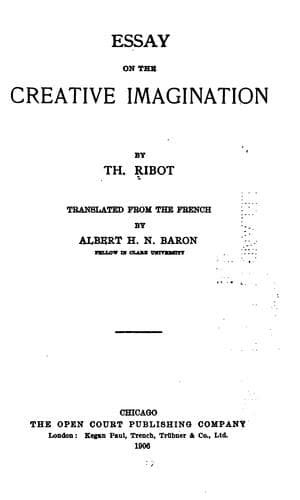
Essay on the Creative ImaginationRibot, Th. (Théodule)
Science
Essay on the Creative Imagination
Ribot, Th. (Théodule)
Creation (Literary, artistic, etc.); Imagination
By "intuition" we generally understand a practical, immediate judgment
that goes straight to the goal. Tact, wisdom, scent, divination, are
synonymous or equivalent expressions. First let us note that intuition
does not belong exclusively to this part of our subject, for it is found
_in parvo_ throughout; but in commercial invention it is preponderating
on account of the necessity of perceiving quickly and surely, and of
grasping chances. "Genius for business," someone has said, "consists in
making exact hypotheses regarding the fluctuations of values." To
characterize the mental state is easy, if it is a matter merely of
giving examples; very difficult, if one attempts to discover its
mechanism.
The physician who in a trice diagnoses a disease, who, on a higher
level, groups symptoms in order to deduce a new disease from them, like
Duchenne de Boulogne; the politician who knows human nature, the
merchant who scents a good venture, etc., furnish examples of intuition.
It does not depend on the degree of culture;--not to mention women,
whose insight into practical matters is well known, there are ignorant
people--peasants, even savages--who, in their limited sphere, are the
equals of fine diplomats.
But all these facts teach us nothing concerning its psychological
nature. Intuition presupposes acquired experience of a special nature
that gives the judgment its validity and turns it in a particular
direction. Nevertheless, this accumulated knowledge of itself gives no
evidence as to the future. Now, every intuition is an anticipation of
the future, resulting from only two processes:--inductive or deductive
reasoning, e.g., the chemist foreseeing a reaction; imagination, i.e.,
a representative construction. Which is the chief process here?
Evidently the former, because it is not a matter of fancied hypothesis,
but of adaptation of former experience to a new case. Intuition
resembles logical operations much more than it does imaginative
combinations. We may liken it to unconscious reasoning, if we are not
afraid of the seeming contradiction of this expression which supposes a
logical operation without consciousness of the middle term. Although
questionable, it is perhaps to be preferred to other proposed
explanations--such as automatism, habit, "instinct," "nervous
connections." Carpenter, who as promoter of "unconscious cerebration,"
deserves to be consulted, likens this state to reflection. In ending, he
reprints a letter that John Stuart Mill wrote to him on the subject, in
which he says in substance that this capacity is found in persons who
have experience and lean toward practical things, but attach little
importance to theory.[131]
Public-domain text, read in full here on John Shaqi.
Reviews
Reviews
No reviews yet
Be the first to share your thoughts on this work.
Elsewhere in the archive
Join the Discussion
Join the discussion
Sign in to leave a comment or review.
Sign InorCreate an account