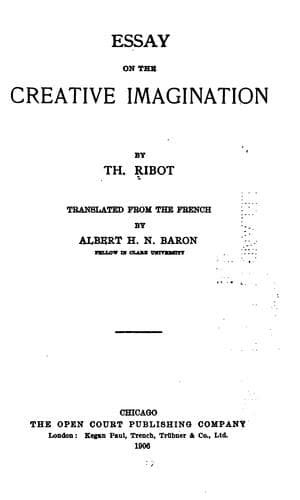
Essay on the Creative ImaginationRibot, Th. (Théodule)
Science
Essay on the Creative Imagination
Ribot, Th. (Théodule)
Creation (Literary, artistic, etc.); Imagination
There is invention operating on great masses--social or political
invention strictly so called--ordinarily not proposed but imposed,
which, however, despite its coercive power, is subject to requirements
even more numerous than mechanical, industrial, or commercial invention.
It has to struggle against natural forces, but most of all against human
forces--inherited habits, customs, traditions. It must make terms with
dominant passions and ideas, finding its justification, like all other
creation, only in success.
Without entering into the details of this inevitable determination,
which would require useless repetition, we may sum up the role of the
constructive imagination in social matters by saying that it has
undergone a regression--i.e., that its area of development has been
little by little narrowed; not that inventive genius, reduced to pure
construction in images, has suffered an eclipse, but on its part it has
had to make increasingly greater room for experiment, rational elements,
calculation, inductions and deductions that permit foresight--for
practical necessities.
If we omit the spontaneous, instinctive, semi-conscious invention of the
earliest ages, that was sufficient for primitive societies, and keep to
creations that were the result of reflection and of great pretension, we
can roughly distinguish three successive periods:
(1) A very long idealistic phase (Antiquity, Renaissance) when triumphed
the pure imagination, and the play of the free fancy that spends itself
in social novels. Between the creation of the mind and the life of
contemporary society there was no relation; they were worlds apart,
strangers to one another. The true Utopians scarcely troubled themselves
to make applications. Plato and More--would they have wished to realize
their dreams?
(2) An intermediate phase, when an attempt is made to pass from the
ideal to the practical, from pure speculation to social facts. Already,
in the eighteenth century, some philosophers (Locke, Rousseau) drew up
constitutions, at the request of interested persons. During this period,
when the work of the imagination, instead of merely becoming fixed in
books, tends to become objectified in acts, we find many failures and
some successes. Let us recall the fruitless attempts of the
"phalansteries" in France, in Algeria, Brazil, and in the United States.
Robert Owen was more fortunate;[145] in four years he reformed New
Larnak, after his ideal, and with varying fortune founded short-lived
colonies. Saint-Simonism has not entirely died out; the primitive
civilization after his ideal rapidly disappeared, but some of his
theories have filtered into or have become incorporated with other
doctrines.
Public-domain text, read in full here on John Shaqi.
Reviews
Reviews
No reviews yet
Be the first to share your thoughts on this work.
Elsewhere in the archive
Join the Discussion
Join the discussion
Sign in to leave a comment or review.
Sign InorCreate an account