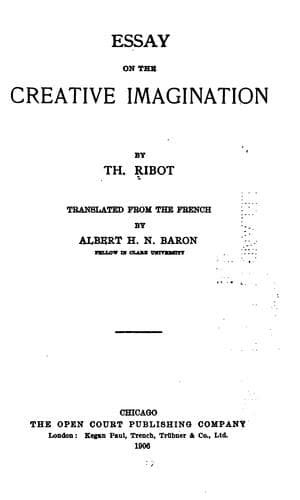
Essay on the Creative ImaginationRibot, Th. (Théodule)
Science
Essay on the Creative Imagination
Ribot, Th. (Théodule)
Creation (Literary, artistic, etc.); Imagination
(3) A phase in which imaginative creation becomes subordinated to
practical life: The conception of society ceases to be purely idealistic
or constructed _a priori_ by deduction from a single principle; it
recognizes the conditions of its environment, adapts itself to the
necessities of its development. It is the passage from the absolutely
autonomous state of the imagination to a period when it submits to the
laws of a rational imperative. In other words, the transition from the
esthetic to the scientific, and especially the practical, form.
Socialism is a well-known and excellent example of this. Compare its
former utopias, down to about the middle of the last century, with its
contemporary forms, and without difficulty we can appreciate the amount
of imaginative elements lost in favor of an at least equivalent quantity
of rational elements and positive calculations.
FOOTNOTES:
[139] This title, as will be seen later, corresponds only in part to
the contents of this chapter.
[140] For facts in support, see the _Psychology of the Emotions_,
Second Part, chapter VIII.
[141] Our author does not mention Bacon's _New Atlantis_, one of the
best specimens of its kind. "Wisest Verulam," active and
distinguished in so many fields, is not amenable to rules, and is
here found among "idealists," as elsewhere among the foremost
empiricists and iconoclasts. (Tr.)
[142] See above, Part III, chapter III.
[143] We recommend to the reader the "Epilogue sur l'Analogie," in
_Le Monde Industriel_, pp. 244 ff., where he will learn that the
"goldfinch depicts the child born of poor parents; the pheasant
represents the jealous husband; the cock is the symbol of the man of
the world; the cabbage is the emblem of mysterious love," etc. There
are several pages in this tone, with alleged reasons in support of
the statements.
[144] See above, chapter II.
[145] For an excellent account of the principles of these movements,
see Rae, _Contemporary Socialism_; for Owen's ideals, his
_Autobiography_; and for an account of some of the trials, Bushee's
"Communistic Societies in the United States," _Political Science
Quarterly_, vol. XX, pp. 625 ff. (Tr.)
CONCLUSION.
CONCLUSION
I
THE FOUNDATIONS OF THE CREATIVE IMAGINATION
Why is the human mind able to create? In a certain sense this question
may seem idle, childish, and even worse. We might just as well ask why
does man have eyes and not an electric apparatus like the torpedo? Why
does he perceive directly sounds but not the ultra-red and ultra-violet
rays? Why does he perceive changes of odors but not magnetic changes?
And so on _ad infinitum_. We will put the question in a very different
manner: Being given the physical and mental constitution of man such as
it is at present, how is the creative imagination a natural product of
this constitution?
Public-domain text, read in full here on John Shaqi.
Reviews
Reviews
No reviews yet
Be the first to share your thoughts on this work.
Elsewhere in the archive
Join the Discussion
Join the discussion
Sign in to leave a comment or review.
Sign InorCreate an account