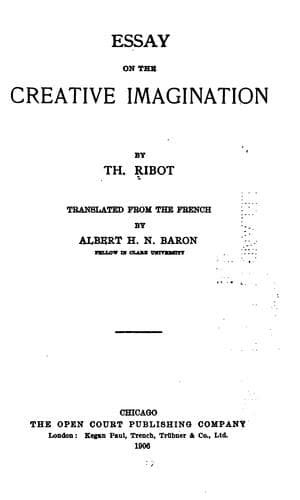
Essay on the Creative ImaginationRibot, Th. (Théodule)
Science
Essay on the Creative Imagination
Ribot, Th. (Théodule)
Creation (Literary, artistic, etc.); Imagination
The "sketched" form is or remains an elementary, primitive, automatic
form. Conformably to the general law ruling the development of
mind--passage from indefinite to definite, from the incoherent to the
coherent, from spontaneity to reflection, from the reflex to the
voluntary period--the imagination comes out of its swaddling-clothes,
is changed--through the intervention of a teleological act that assigns
it an end; through the union of rational elements that subdue it for an
adaptation. Then appear the other two forms.
(b) The _fixed_ form comprises mythic and esthetic creations,
philosophical and scientific hypotheses. While the "outline" imagination
remains an internal phenomenon, existing only in and for a single
individual, the fixed form is projected outwards, made something else.
The former has no reality other than the momentary belief accompanying
it; the latter exists by itself, for its creator and for others; the
work is accepted, rejected, examined, criticised. Fiction rests on the
same level as reality. Do not people discuss seriously the objective
value of certain myths, and of metaphysical theories? the action of a
novel or drama as though it were a matter of real events? the character
of the _dramatis personae_ as though they were living flesh and blood?
The fixed imagination moves in an elastic frame. The material elements
circumscribing it and composing it have a certain fluidity; they are
language, writing, musical sounds, colors, forms, lines. Furthermore, we
know that its creations, in spite of the spontaneous adherence of the
mind accepting them, are the work of a free will; they could have been
otherwise--they preserve an indelible imprint of contingency and
subjectivity.
(c) This last mark is rubbed out without disappearing (for a thing
imagined is always a personal thing) in the objectified form that
comprises successful practical inventions--whether mechanical,
industrial, commercial, military, social, or political. These have no
longer an arbitrary, borrowed reality; they have their place in the
totality of physical and social phenomena. They resemble creations of
nature, subject like them to fixed conditions of existence and to a
limited determinism. We shall not dwell longer on this last character,
so often pointed out.
Public-domain text, read in full here on John Shaqi.
Reviews
Reviews
No reviews yet
Be the first to share your thoughts on this work.
Elsewhere in the archive
Join the Discussion
Join the discussion
Sign in to leave a comment or review.
Sign InorCreate an account