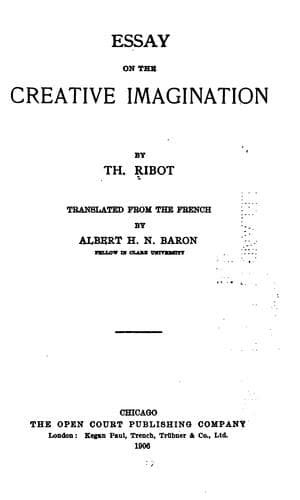
Essay on the Creative ImaginationRibot, Th. (Théodule)
Science
Essay on the Creative Imagination
Ribot, Th. (Théodule)
Creation (Literary, artistic, etc.); Imagination
In many animals that are endowed only with memory the return of images
is always provoked. Sensation from without or from within bring them
into consciousness under the form, pure and simple, of former
experience; whence we have reproduction, repetition without new
associations. People of slight imagination and used to routine approach
this mental condition. But, as a matter of fact, man from his second
year on, and some higher animals, go beyond this stage--they are capable
of spontaneous revival. By this term I mean that revival that comes
about abruptly, without _apparent_ antecedents. We know that these act
in a latent form, and consist of thinking by analogy, affective
dispositions, unconscious elaboration. This sudden appearance excites
other states which, grouped into new associations, contain the first
elements of the creative act.
Taken altogether, and however numerous its manifestations, the
constructive imagination seems to me reducible to three forms, which I
shall call _sketched_, _fixed_, _objectified_, according as it remains
an internal fancy, or takes on a material but contingent and unstable
form, or is subjected to the conditions of a rigorous internal or
external determinism.
(a) The _sketched_ form is primordial, original, the simplest of all; it
is a nascent moment or first attempt. It appears first of all in
dreaming--an embryonic, unstable and uncoordinated manifestation of the
creative imagination--a transition-stage between passive reproduction
and organized construction. A step higher is revery, whose flitting
images, associated by chance, without personal intervention, are
nevertheless vivid enough to exclude from consciousness every impression
of the external world--so much so that the day-dreamer re-enters it only
with a shock of surprise. More coherent are the imaginary constructions
known as "castles in Spain"--the works of a wish considered
unrealizable, fancies of love, ambition, power and wealth, the goal of
which seems to be forever beyond our reach. Lastly, still higher, come
all the plans for the future conceived vaguely and as barely
possible--foreseeing the end of a sickness, of a business enterprise, of
a political event, etc.
This vague and "outline" imagination, penetrating our entire life, has
its peculiar characters--the unifying principle is _nil_ or ephemeral,
which fact always reduces it to the dream as a type; it does not
externalize itself, does not change into acts, a consequence of its
basically chimerical nature or of weakness of will, which reduces it to
a strictly internal and individual existence. It is needless to say that
this kind of imagination is a permanent and definite form with the
dreamers living in a world of ceaselessly reappearing images, having no
power to organize them, to change them into a work of art, a theory, or
a useful invention.
Public-domain text, read in full here on John Shaqi.
Reviews
Reviews
No reviews yet
Be the first to share your thoughts on this work.
Elsewhere in the archive
Join the Discussion
Join the discussion
Sign in to leave a comment or review.
Sign InorCreate an account