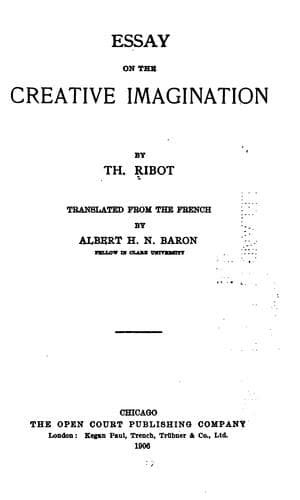
Essay on the Creative ImaginationRibot, Th. (Théodule)
Science
Essay on the Creative Imagination
Ribot, Th. (Théodule)
Creation (Literary, artistic, etc.); Imagination
In order to thoroughly comprehend the absolute necessity for
dissociation, let us note that total redintegration is _per se_ a
hindrance to creation. Examples are given of people who can easily
remember twenty or thirty pages of a book, but if they want a particular
passage they are unable to pick it out--they must begin at the beginning
and continue down to the required place. Excessive ease of retention
thus becomes a serious inconvenience. Besides these rare cases, we know
that ignorant people, those intellectually limited, give the same
invariable story of every occurrence, in which all the parts--the
important and the accessory, the useful and the useless--are on a dead
level. They omit no detail, they cannot select. Minds of this kind are
inapt at invention. In short, we may say that there are two kinds of
memory: one is completely systematized, e.g., habits, routine, poetry
or prose learned by heart, faultless musical rendering, etc. The
acquisition forms a compact whole and cannot enter into new
combinations. The other is not systematized; it is composed of small,
more or less coherent groups. This kind of memory is plastic and capable
of becoming combined in new ways.
We have enumerated the spontaneous, natural causes of association,
omitting the voluntary and artificial causes, which are but their
imitations. As a result of these various causes, images are taken to
pieces, shattered, broken up, but made all the readier as materials for
the inventor. This is a process analogous to that which, in geologic
time, produces new strata through the wearing away of old rocks.
II
Association is one of the big questions of psychology; but as it does
not especially concern our subject, it will be discussed in strict
proportion to its use here. Nothing is easier than limiting ourselves.
Our task is reducible to a very clear and very brief question: What are
the forms of association that give rise to new combinations and under
what influences do they arise? All other forms of association, those
that are only repetitions, should be eliminated. Consequently, this
subject can not be treated in one single effort; it must be studied, in
turn, in its relations to our three factors--intellectual, emotional,
unconscious.
It is generally admitted that the expression "association of ideas" is
faulty.[8] It is not comprehensive enough, association being active also
in psychic states other than ideas. It seems indicative rather of mere
juxtaposition, whereas associated states modify one another by the very
fact of their being connected. But, as it has been confirmed by long
usage, it would be difficult to eliminate the phrase.
Public-domain text, read in full here on John Shaqi.
Reviews
Reviews
No reviews yet
Be the first to share your thoughts on this work.
Join the Discussion
Join the discussion
Sign in to leave a comment or review.
Sign InorCreate an account