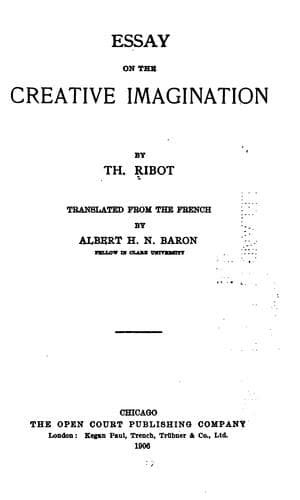
Essay on the Creative ImaginationRibot, Th. (Théodule)
Science
Essay on the Creative Imagination
Ribot, Th. (Théodule)
Creation (Literary, artistic, etc.); Imagination
How may we rightly assert that a form of imaginative life is clearly
pathologic? In my opinion, the answer must be sought in the nature and
degree of belief accompanying the labor of creating. It is an axiom
unchallenged by anyone--whether idealist or realist of any shade of
belief--that nothing has existence for us save through the consciousness
we have of it; but for realism--and experimental psychology is of
necessity realistic--there are two distinct forms of existence.
One, subjective, having no reality except in consciousness, for the one
experiencing it, its reality being due only to belief, to that first
affirmation of the mind so often described.
The other, objective, existing in consciousness and outside of it, being
real not only for me but for all those whose constitution is similar or
analogous to mine.
This much borne in mind, let us compare the last two degrees of the
development of the imaginative life.
For the imaginer of the third stage, the two forms of existence are not
confounded. He distinguishes _two_ worlds, preferring one and making
the best of the other, but believing in both. He is conscious of passing
from one to the other. There is an alternation. The observation of Fere,
although extreme, is a proof of this.
At the fourth stage, in the insane, imaginative labor--the only kind
with which we are concerned--is so systematized that the distinction
between the two kinds of existence has disappeared. All the phantoms of
his brain are invested with objective reality. Occurrences without, even
the most extraordinary, do not reach one in this stage, or else are
interpreted in accordance with the diseased fancy. There is no longer
any alternation.[154]
By way of summary we may say: The creative imagination consists of the
property that images have of gathering in new combinations, through the
effect of a spontaneity whose nature we have attempted to describe. It
always tends to realize itself in degrees that vary from mere momentary
belief to complete objectivity. Throughout its multiple manifestations,
it remains identical with itself in its basic nature, in its
constitutive elements. The diversity of its deeds depends on the end
desired, the conditions required for its attainment, materials employed
which, as we have seen, under the collective name "representations" are
very unlike one another, not only as regards their sensuous origin
(visual, auditory, tactile, etc.) but also as regards their psychologic
nature (concrete, symbolic, affective, emotional-abstract images;
generic and schematic images, concepts--each group itself having shades
or degrees).
Public-domain text, read in full here on John Shaqi.
Reviews
Reviews
No reviews yet
Be the first to share your thoughts on this work.
Elsewhere in the archive
Join the Discussion
Join the discussion
Sign in to leave a comment or review.
Sign InorCreate an account