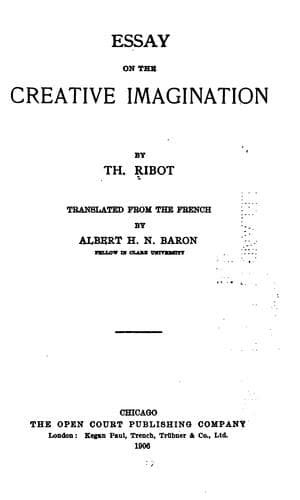
Essay on the Creative ImaginationRibot, Th. (Théodule)
Science
Essay on the Creative Imagination
Ribot, Th. (Théodule)
Creation (Literary, artistic, etc.); Imagination
This constructive activity, applying itself to everything and radiating
in all directions, is in its early, typical form a mythic creation. It
is an invincible need of man to reflect and reproduce his own nature in
the world surrounding him. The first application of his mind is thinking
by analogy, which vivifies everything after the human model and attempts
to know everything according to arbitrary resemblances. Myth-making
activity, which we have studied in the child and in primitive man, is
the embryonic form whence arise by a slow evolution religious
creations--gross or refined; esthetic development, which is a fallen,
impoverished mythology; the fantastic conceptions of the world that may
little by little become scientific conceptions, with, however, an
irreducible residuum of hypotheses. Alongside of these creations, all
bordering upon what we have called the fixed form, there are practical,
objective creations. As for the latter, we could not trace them to the
same mythic source except by dialectic subtleties which we renounce. The
former arise from an internal efflorescence; the latter from urgent
life-needs; they appear later and are a bifurcation of the early trunk:
but the same sap flows in both branches.
The constructive imagination penetrates every part of our life, whether
individual or collective, speculative and practical, in all its
forms--IT IS EVERYWHERE.
FOOTNOTES:
[146] See above, Part I, chapter II.
[147] It is a postulate of contemporary physiology that all the
neurones taken together cannot spontaneously, that is, of
themselves, give rise to any movement--they receive from without,
and expend their energy outwards. Nevertheless, between the two
moments that, in reflex and instinctive actions, seem continuous, a
third interposes, which, for the higher psychic acts, may be of long
duration. Thus, reasonings in logical form and reflection regarding
a decision to be made have a feeble tendency to become changed into
acts; their motor effects are indirect, and at a long range. But
this intermediate moment is _par excellence_ the moment for
psychology. It is also the moment of the personal equation: every
man receives, transforms, and restores outwards according to his own
organization, temperament, idiosyncrasies, character--in a word,
according to his personality, of which needs, tendencies, desires,
are the direct and immediate expression. So we come back, by another
route, to the same definition of spontaneity.
[148] Besides these three principal forms, there are intermediate
forms, transitions from one category to another, that are hard to
classify: certain mythic creations are half-sketched, half-fixed;
and we find religious and social and political conceptions, partly
theoretic or fixed, partly practical or objective.
[149] Taine, _On Intelligence_, Part I, Book II, ch. I.
[150] See Appendix E.
Public-domain text, read in full here on John Shaqi.
Reviews
Reviews
No reviews yet
Be the first to share your thoughts on this work.
Elsewhere in the archive
Join the Discussion
Join the discussion
Sign in to leave a comment or review.
Sign InorCreate an account