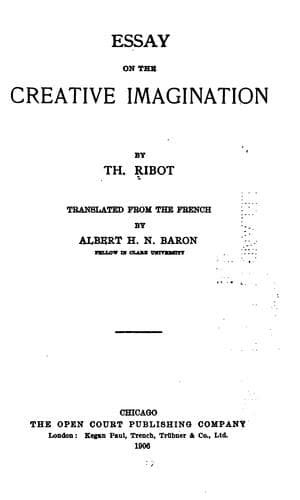
Essay on the Creative ImaginationRibot, Th. (Théodule)
Science
Essay on the Creative Imagination
Ribot, Th. (Théodule)
Creation (Literary, artistic, etc.); Imagination
It has been proven through numerous experiments (Fere, Binet, Mosso,
Janet, Newbold, etc.) that "unconscious sensations"[160] act, since they
produce the same reactions as conscious sensations, and Mosso has been
able to maintain that "the testimony of consciousness is less certain
than that of the sphygmograph." But the particular instance of invention
is very different; for it does not merely suppose the adaptation to an
end which the physiological factor would suffice to explain; it implies
a series of adaptations, corrections, rational operations, of which
nervous activity alone furnishes us no example.[161]
2. The psychological theory is based on an equivocal use of the word
consciousness. Consciousness has one definite mark--it is an internal
event existing, not by itself, but for me and insofar as it is known by
me. But the psychological theory of the unconscious assumes that if we
descend from clear consciousness progressively to obscure consciousness,
to the subconscious, to the unconscious that manifests itself only
through its motor reactions, the first state thus successively
impoverished, still remains, down to its final term, identical in its
basis with consciousness. It is an hypothesis that nothing justifies.
No difficulty arises when we bear in mind the legitimate distinction
between consciousness of self and consciousness in general, the former
entirely subjective, the latter in a way objective (the consciousness of
a man captivated by an attractive scene; better yet, the fluid form of
revery or of the awaking from syncope). We may admit that this
evanescent consciousness, affective in nature, felt rather than
perceived, is due to a lack of synthesis, of relations among the
internal states, which remain isolated, unable to unite into a whole.
The difficulty commences when we descend into the region of the
subconscious, which allows stages whose obscurity increases in
proportion as we move away from clear consciousness, "like a lake in
which the action of light is always nearing extinction" (in double
coexisting personalities, automatic writing, mediums, etc.). Here some
postulate two currents of consciousness existing at the same time in one
person without reciprocal connection. Others suppose a "field of
consciousness" with a brilliant center and extending indefinitely toward
the dim distance. Still others liken the phenomenon to the movement of
waves, whose summit alone is lighted up. Indeed, the authors declare
that with these comparisons and metaphors they make no pretense of
explaining; but certainly they all reduce unconsciousness to
consciousness, as a special to a general case, and what is that if not
explaining?
Public-domain text, read in full here on John Shaqi.
Reviews
Reviews
No reviews yet
Be the first to share your thoughts on this work.
Elsewhere in the archive
Join the Discussion
Join the discussion
Sign in to leave a comment or review.
Sign InorCreate an account