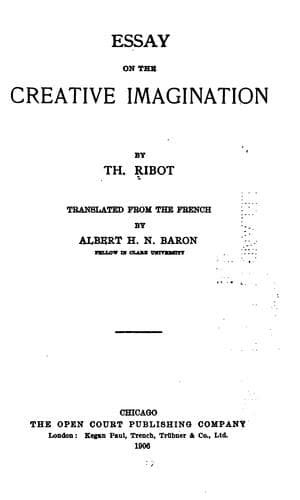
Essay on the Creative ImaginationRibot, Th. (Théodule)
Science
Essay on the Creative Imagination
Ribot, Th. (Théodule)
Creation (Literary, artistic, etc.); Imagination
Insofar as the facts are concerned, it would be well, I think, to
establish two categories--(1) static unconscious, comprising habits,
memory, and, in general, all that is organized knowledge. It is a state
of preservation, of rest; very relatively, since representations suffer
incessant corrosion and change. (2) Dynamic unconscious, which is a
state of latent activity, of elaboration and incubation. We might give a
multitude of proofs of this unconscious rumination. The well-known fact
that an intellectual work gains by being interrupted; that in resuming
it one often finds it cleared up, changed, even accomplished, was
explained by some psychologists prior to Carpenter by "the resting of
the mind." It would be just as valid to say that a traveler covers
leagues by lying abed. The author just mentioned[159] has brought
together many observations in which the solution of a mathematical,
mechanical, commercial problem appeared suddenly after hours and days of
vague, undefinable uneasiness, the cause of which is unknown, which,
however, is only the result of an underlying cerebral working; for the
trouble, sometimes rising to anguish, ceases as soon as the unawaited
conclusion has entered consciousness. The men who think the most are not
those who have the clearest and "most conscious" ideas, but those having
at their disposal a rich fund of unconscious elaboration. On the other
hand, shallow minds have a naturally poor unconscious fund, capable of
but slight development; they give out immediately and rapidly all that
they are able to give; they have no reserve. It is useless to allow them
time for reflection or invention. They will not do better; they may do
worse.
As to the nature of the unconscious working, we find disagreement and
darkness. One may doubtless maintain, theoretically, that in the
inventor everything goes on in subconsciousness and in unconsciousness,
just as in consciousness itself, with the exception that a message does
not arrive as far as the self; that the labor that may be followed, in
clear consciousness, in its progress and retreats, remains the same when
it continues unknown to us. This is possible. Yet it must at least be
recognized that consciousness is rigorously subject to the condition of
time, the unconscious is not. This difference, not to mention others, is
not negligible, and could well arouse other problems.
The contemporary theories regarding the nature of the unconscious seem
to me reducible to two principal positions--one psychological, the other
physiological.
1. The physiological theory is simple and scarcely permits any
variations. According to it, unconscious activity is simply cerebral; it
is an "unconscious cerebration." The psychic factor, which ordinarily
accompanies the activity of the nervous centers, is absent. Although I
incline toward this hypothesis, I confess that it is full of
difficulties.
Public-domain text, read in full here on John Shaqi.
Reviews
Reviews
No reviews yet
Be the first to share your thoughts on this work.
Elsewhere in the archive
Join the Discussion
Join the discussion
Sign in to leave a comment or review.
Sign InorCreate an account