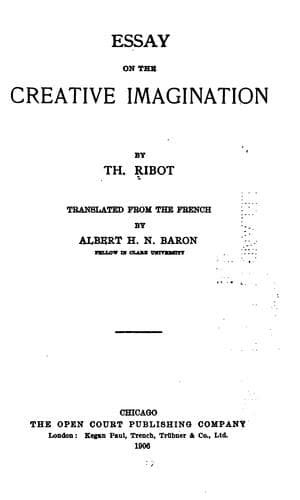
Essay on the Creative ImaginationRibot, Th. (Théodule)
Science
Essay on the Creative Imagination
Ribot, Th. (Théodule)
Creation (Literary, artistic, etc.); Imagination
Personification is the earlier process. It is radical, always identical
with itself, but transitory. It goes out from ourselves toward other
things. It consists in attributing life to everything, in supposing in
everything that shows signs of life--and even in inanimate
objects--desires, passions, and acts of will analogous to ours, acting
like ourselves in view of definite ends. This state of mind is
incomprehensible to an adult civilized man; but it must be admitted,
since there are facts without number that show its existence. We do not
need to cite them--they are too well known. They fill the works of
ethnologists, of travelers in savage lands, of books of mythology.
Besides, all of us, at the commencement of our lives, during our
earliest childhood, have passed through this inevitable stage of
universal animism. Works on child-psychology abound in observations that
leave no possible room for doubt on this point. The child endows
everything with life, and he does so the more in proportion as he is
more imaginative. But this stage, which among civilized people lasts
only a brief period, remains in the primitive man a permanent
disposition and one that is always active. This process of
personification is the perennial fount whence have gushed the greater
number of myths, an enormous mass of superstitions, and a large number
of esthetic productions. To sum up in a word, all things that have been
invented _ex analogia hominis_.
Transformation or metamorphosis is a general, permanent process under
many forms, proceeding not from the thinking subject towards objects,
but from one object to another, from one thing to another. It consists
of a transfer through partial resemblance. This operation rests on two
fundamental bases--depending at one time on vague resemblances (a cloud
becomes a mountain, or a mountain a fantastic animal; the sound of the
wind a plaintive cry, etc.), or again, on a resemblance with a
predominating emotional element: A perception provokes a feeling, and
becomes the mark, sign, or plastic form thereof (the lion represents
courage; the cat, artifice; the cypress, sorrow; and so on). All this,
doubtless, is erroneous or arbitrary; but the function of the
imagination is to invent, not to perceive. All know that this process
creates metaphors, allegories, symbols; it should not, however, be
believed on that account that it remains restricted to the realm of art
or of the development of language. We meet it every moment in practical
life, in mechanical, industrial, commercial, and scientific invention,
and we shall, later, give a large number of examples in support of this
statement.
Public-domain text, read in full here on John Shaqi.
Reviews
Reviews
No reviews yet
Be the first to share your thoughts on this work.
Join the Discussion
Join the discussion
Sign in to leave a comment or review.
Sign InorCreate an account