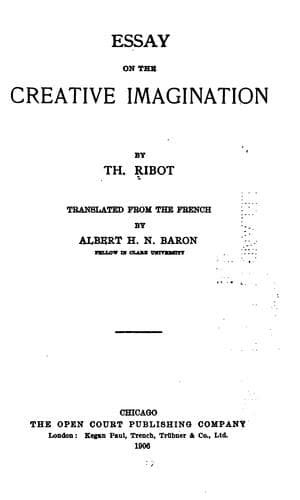
Essay on the Creative ImaginationRibot, Th. (Théodule)
Science
Essay on the Creative Imagination
Ribot, Th. (Théodule)
Creation (Literary, artistic, etc.); Imagination
There are unusual and remarkable cases with an exceptional emotional
base. Of such is "colored hearing." We know that several hypotheses have
been offered in regard to the origin of this phenomenon.
Embryologically, it would seem to be the result of an incomplete
separation between the sense of sight and that of hearing, and the
survival, it is said, from a distant period of humanity, when this state
must have been the rule; anatomically, the result of supposed
anastamoses between the cerebral centers for visual and auditory
sensations; physiologically, the result of nervous irradiation;
psychologically, the result of association. This latter hypothesis seems
to account for the greater number of instances, if not for all; but, as
Flournoy has observed, it is a matter of "affective" imagination. Two
sensations absolutely unlike (for instance, the color blue and the
sound _i_) may resemble one another through the equal retentive quality
that they possess in the organism of some favored individuals, and this
emotional factor becomes a bond of association. Observe that this
hypothesis explains also the much more unusual cases of "colored" smell,
taste, and pain; that is, an abnormal association between given colors
and tastes, smells, or pains.
Although we meet them only as exceptional cases, these modes of
association are susceptible to analysis, and seem clear, almost
self-evident, if we compare them with other, subtle, refined, barely
perceptible cases, the origin of which is a subject for supposition, for
guessing rather than for clear comprehension. It is, moreover, a sort of
imagination belonging to very few people: certain artists and some
eccentric or unbalanced minds, scarcely ever found outside the esthetic
or practical life. I wish to speak of the forms of invention that permit
only fantastic conceptions, of a strangeness pushed to the extreme
(Hoffman, Poe, Baudelaire, Goya, Wiertz, etc.), or surprising,
extraordinary thoughts, known of no other men (the symbolists and
decadents that flourish at the present time in various countries of
Europe and America, who believe, rightly or wrongly, that they are
preparing the esthetics of the future). It must be here admitted that
there exists an altogether special manner of _feeling_, dependent on
temperament at first, which many cultivate and refine as though it were
a precious rarity. There lies the true source of their invention.
Doubtless, to assert this pertinently, it would be necessary to
establish the direct relations between their physical and psychical
constitution and that of their work; to note even the particular states
at the moment of the creative act. To me at least, it seems evident that
the novelty, the strangeness of combinations, through its deep
subjective character, indicates an emotional rather than an intellectual
origin. Let us merely add that these abnormal manifestations of the
creative imagination belong to the province of pathology rather than to
that of psychology.
Public-domain text, read in full here on John Shaqi.
Reviews
Reviews
No reviews yet
Be the first to share your thoughts on this work.
Join the Discussion
Join the discussion
Sign in to leave a comment or review.
Sign InorCreate an account