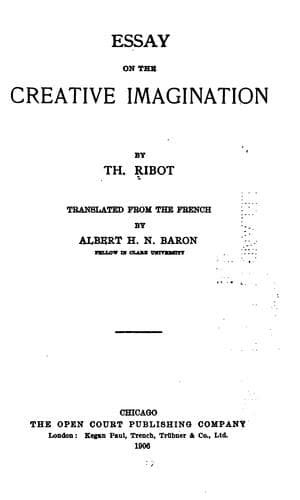
Essay on the Creative ImaginationRibot, Th. (Théodule)
Science
Essay on the Creative Imagination
Ribot, Th. (Théodule)
Creation (Literary, artistic, etc.); Imagination
Nowadays we attribute the greatest importance to the morphology of the
brain, to its histological structure, the marked development of certain
regions, the determination not only of centers but of connections and
associations between centers. On this last point contemporary anatomists
have given themselves up to eager researches, and, although the cerebral
architecture is not conceived by all in the same way, it is proper for
psychology to note that all with their "centers" or "associational
system" try to translate into their own language the complex conditions
of mental life. Since we must choose from among these various anatomical
views let us accept that of Flechsig, one of the most renowned and one
having also the advantage of putting directly the problem of the organic
conditions of the imagination.
We know that Flechsig relies on the embryological method--that is, on
the development--in the order of time, of nerves and centers. For him
there exist on the one hand sensitive regions (sensory-motor), occupying
about a third of the cortical surface; on the other hand,
association-centers, occupying the remaining part.
So far as the sensory centers are concerned, development occurs in the
following order: Organic sensations (middle of cerebral cortex), smell
(base of the brain and part of the frontal lobes), sight (occipital
lobe), hearing (first temporal). Whence it results that in a definite
part of the brain the body comes to proper consciousness of its
impulses, wants, appetites, pains, movements, etc., and that this part
develops first--"knowledge of the body precedes that of the outside
world."
In what concerns the associational centers, Flechsig supposes three
regions: The great posterior center (parieto-occipito-temporal);
another, much smaller, anterior or frontal; and a middle center, the
smallest of all (the Island of Reil). Comparative anatomy proves that
the associational centers are more important than those of sensation.
Among the lower mammals they develop as we go up the scale: "That which
makes the psychic man may be said to be the centers of association that
he possesses." In the new-born child the sensitive centers are isolated,
and, in the absence of connections between them, the unity of the self
cannot be manifested; there is a plurality of consciousness.
Public-domain text, read in full here on John Shaqi.
Reviews
Reviews
No reviews yet
Be the first to share your thoughts on this work.
Join the Discussion
Join the discussion
Sign in to leave a comment or review.
Sign InorCreate an account