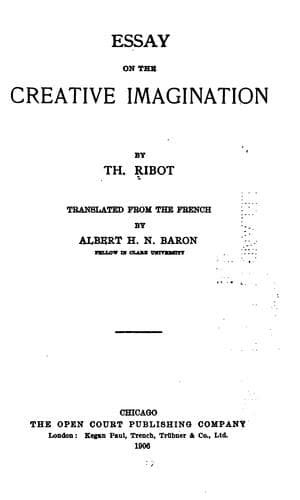
Essay on the Creative ImaginationRibot, Th. (Théodule)
Science
Essay on the Creative Imagination
Ribot, Th. (Théodule)
Creation (Literary, artistic, etc.); Imagination
Neuropathy was for him the exaggeration of vital properties and
consequently the most favorable condition for the hatching of works of
genius. Later, Lombroso, in a book teeming with doubtful or manifestly
false evidence, finding his predecessor's theory too vague, attempts to
give it more precision by substituting for neurosis in general a
specific neurosis--larvated epilepsy. Alienists, far from eagerly
accepting this view, have set themselves to combat it and to maintain
that Lombroso has compromised everything in wanting to make the term too
precise. There are several possible hypotheses, they say: either the
neuropathic state is the direct, immediate cause of which the higher
faculties of genius are effects; or, the intellectual superiority,
through the excessive labor and excitation it involves, causes
neuropathic disturbances; or, there is no relation of cause and effect
between genius and neurosis, but mere coexistence, since there are found
very mediocre neuropaths, and men above the average without a neurotic
blemish; or, the two states--the one psychic, the other
physiological--are both effects, resulting from organic conditions that
produce according to circumstances genius, insanity, and divers nervous
troubles. Every one of these hypotheses can allege facts in its favor.
We must, however, recognize that in most men of genius are found so many
peculiarities, physical eccentricities and disorders of all kinds that
the pathologic theory retains much probability.
There remain for consideration the sane geniuses who, despite many
efforts and subtleties, have not yet been successfully brought under the
foregoing formula, and who have made possible the enunciation of another
theory. Recently, Nordau, rejecting the theory of his master Lombroso,
has maintained that it is just as reasonable to say that "genius is a
neurosis" as that "athleticism is a cardiopathy" because many athletes
are affected with heart disease. For him, "the essential elements of
genius are judgment and will." Following this definition, he establishes
the following hierarchy of men of genius: At the highest rung of the
ladder are those in whom judgment and will are equally powerful; men of
action who make world-history (Alexander, Cromwell, Napoleon)--these are
masters of men. On the second level are found the geniuses of judgment,
with no hyper-development of will--these are masters of matter (Pasteur,
Helmholtz, Roentgen). On the third step are geniuses of judgment without
energetic will--thinkers and philosophers. What then shall we do with
the emotional geniuses--the poets and artists? Theirs is not genius in
the strict sense, "because it creates nothing new and exercises no
influence on phenomena." Without discussing the value of this
classification, without examining whether it is even possible,--since
there is no common measure between Alexander, Pasteur, Shakespeare, and
Spinoza,--and whether, on the other hand, common opinion is not right in
Public-domain text, read in full here on John Shaqi.
Reviews
Reviews
No reviews yet
Be the first to share your thoughts on this work.
Elsewhere in the archive
Join the Discussion
Join the discussion
Sign in to leave a comment or review.
Sign InorCreate an account