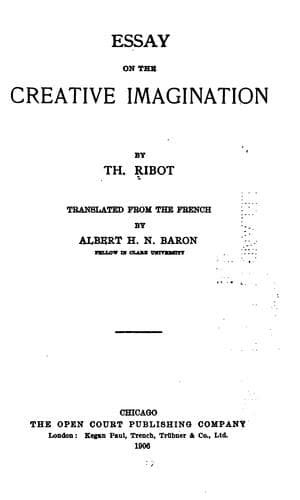
Essay on the Creative ImaginationRibot, Th. (Théodule)
Science
Essay on the Creative Imagination
Ribot, Th. (Théodule)
Creation (Literary, artistic, etc.); Imagination
_The tendency toward spontaneous variation (invention) is always in
inverse ratio to the simplicity of the environment._
The savage environment is in its nature very simple, consequently
homogeneous. The lower races show a much smaller degree of
differentiation than the higher; in them, as Jastrow says, physical and
psychic maturity is more precocious, and as the period just before the
adult age is the plastic period _per se_, this diminishes the chances of
a departure from the common type. Thus comparison between whites and
blacks, between primitive and civilized peoples, shows that, for equal
populations, there is an enormous disproportion as to the number of
innovators.
The barbarian environment is much more complex and heterogeneous: it
contains all the rudiments of civilized life. Consequently, it favors
more individual variations and is richer in superior men. But these
variations are rarely produced outside of a very restricted
field--political, military, religious. So it seems impossible to agree
with Joly[70] that neither primitive nor barbarian peoples produce
superior minds, "unless," as he says, "by this name we mean those that
simply surpass their congeners." But is there a criterion other than
that? I see none. Greatness is altogether a relative idea; and would not
our great creators seem, to beings better endowed than we, very small?
The civilized environment, requiring division of labor and consequently
a constantly growing complexity of heterogeneous elements, is an open
door for all vocations. Doubtless, the social spirit always retains
something of that tendency toward stagnation that is the rule in lower
social orders; it is more favorable to tradition than to innovation. But
the inevitable necessity of a warm competition between individuals and
peoples is a natural antidote for that natural inertia; it favors useful
variations. Moreover, civilization means evolution; consequently the
conditions under which the imagination is active change with the times.
Let us suppose, Weismann justly says, that in the Samoan Islands there
were born a child having the singular and extraordinary genius of
Mozart. What could he accomplish? At the most, extend the gamut of three
or four tones to seven, and create a few more complex melodies; but he
would be as unable to compose symphonies as Archimedes would have been
to invent an electric dynamo. How many creators have been wrecked
because the conditions necessary for their inventions were lacking?
Roger Bacon foresaw several of our great discoveries; Cardan, the
differential calculus; Van Helmont, chemistry; and it has been possible
to write a book on the forerunners of Darwin.[71] We talk so much of the
free flight of imagination, of the all-comprehensive power of the
creator, that we forget the sociological conditions--not to mention
others--on which they are every moment dependent. In this respect, no
invention is personal in the strict sense; there always remains in it a
Public-domain text, read in full here on John Shaqi.
Reviews
Reviews
No reviews yet
Be the first to share your thoughts on this work.
Elsewhere in the archive
Join the Discussion
Join the discussion
Sign in to leave a comment or review.
Sign InorCreate an account