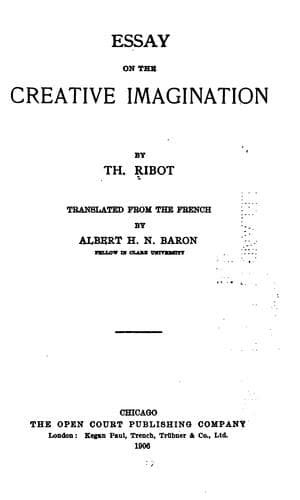
Essay on the Creative ImaginationRibot, Th. (Théodule)
Science
Essay on the Creative Imagination
Ribot, Th. (Théodule)
Creation (Literary, artistic, etc.); Imagination
little of that anonymous collaboration the highest expression of which,
as we have seen, is the mythic activity.
By way of summary, and whatever be the causes, we may say that there is
a universal tendency in all living matter toward variation, whether we
consider vegetables, animals, or the physical and mental man. The need
of innovating is only a special case, rare in the lower races, frequent
in the higher. This tendency toward variation is fundamental or
superficial: As fundamental, it corresponds to genius, and survives
through processes analogous to natural selection, i.e., by its own
power. As superficial, it corresponds to talent, survives and prospers
chiefly through the help of circumstances and environment. Here, the
orientation comes from without, not from within. According as the spirit
of the time inclines rather to poetry or painting, or music, or
scientific research, or industry, or military art, minds of the second
order are dragged into the current--showing that a goodly part of their
power is in the aptness, not for invention, but for _imitation_.
IV
The determination of the characters belonging to the inventive genius
has necessitated some seemingly irrelevant remarks on the action of the
environment. Let us return to invention, strictly so-called.
For inventing there is always required a natural aptitude, sometimes, a
happy chance.
The natural disposition should be accepted as a fact. Why does a man
create? Because he is capable of forming new combinations of ideas.
However naive this answer may be, there is no other. The only thing
possible, is the determination of the conditions necessary and
sufficient for producing novel combinations: this has been done in the
first part of this book, and there is no occasion for going over it
again. But there is another aspect in creative work to be
considered--its psychological _mechanism_, and the form of its
development.
Every normal person creates little or much. He may, in his ignorance,
invent what has been already done a thousand times. Even if this is not
a creation as regards the species, it is none the less such for the
individual. It is wrong to say, as has been said, that an invention "is
a new and important idea." _Novelty_ only is essential--that is the
psychological mark: importance and utility are accessory, merely social
marks. Invention is thus unduly limited when we attribute it to great
inventors only. At this moment, however, we are concerned only with
these, and in them the mechanism of invention is easier to study.
Public-domain text, read in full here on John Shaqi.
Reviews
Reviews
No reviews yet
Be the first to share your thoughts on this work.
Elsewhere in the archive
Join the Discussion
Join the discussion
Sign in to leave a comment or review.
Sign InorCreate an account