In 1745 Hume became tutor to a young nobleman, the Marquis of Annandale,
who was mentally affected, but he did not endure the engagement for
long. Next year General St. Clair, who had been appointed to command an
expedition in the War of the Pragmatic Sanction, invited him to be his
secretary, an office to which that of judge-advocate was afterwards
added. The expedition was a failure, but General St. Clair, who was
afterwards entrusted with embassies to Turin and Vienna, and upon whom
Hume seems to have created a favourable impression, insisted that he
should accompany him in the same capacity as secretary; he further made
him one of his _aides-de-camp_. Thus Hume had to attire his portly
figure in a "scarlet military uniform," and Lord Charlemont who met him
in Turin says that he wore his uniform "like a grocer of the
train-bands." At Vienna the Empress-Dowager excused him on ceremonial
occasions from walking backwards, a concession which was much
appreciated by "my companions who were desperately afraid of my falling
on them and crushing them." Hume returned to London in 1749. "These
years," he says, "were almost the only interruptions my studies have
received during the course of my life. I passed them agreeably and in
good company, and my appointments, with my frugality, had made me reach
a fortune which I called independent, though most of my friends were
inclined to smile when I said so; in short, I was now master of near a
thousand pounds."
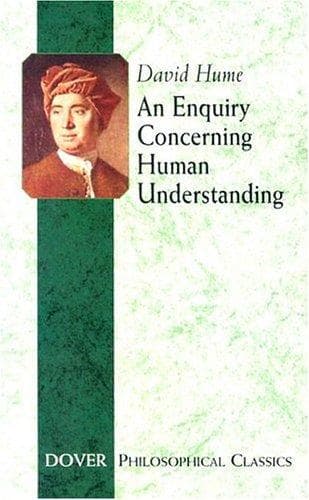
While Hume was away with General St. Clair his _Inquiry Concerning Human
Understanding_ was published, but it was not more successful than the
original _Treatise_ of a portion of which it was a recasting. A new
edition of _Moral and Political Essays_ met with no better fate, but
these disappointments, he says, "made little or no impression" on him.
In 1749 Hume returned to Ninewells, and lived for a while with his
brothers. Afterwards he took a flat of his own at Edinburgh, with his
sister to keep house for him. At this period the _Political Discourses_
and the _Inquiry concerning the Principles of Morals_ were published. Of
the _Inquiry_ Hume held the opinion, an opinion, however, which was not
shared by the critics, that "it is of all my writings--historical,
philosophical, or literary incomparably the best." Slowly and surely his
publications were growing in reputation. In 1752 the Faculty of
Advocates elected Hume their librarian, an office which was valuable to
him, not so much for the emolument as for the extensive library which
enabled him to pursue the historical studies upon which he had for some
time been engaged. For the next nine years he was occupied with his
_History of England_. The first volume was published in 1754, and the
second volume, which met with a better reception than the first, in
1756. Only forty-five copies of the first volume were sold in a
twelvemonth; but the subsequent volumes made rapid headway, and raised a
Public-domain text, read in full here on John Shaqi.
Reviews
Reviews
No reviews yet
Be the first to share your thoughts on this work.
Join the Discussion
Join the discussion
Sign in to leave a comment or review.
Sign InorCreate an account