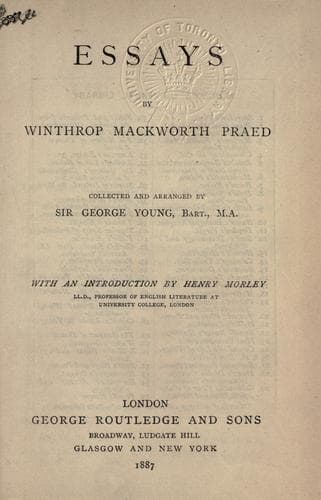
After Praed left Eton, his bent led him to verse, rather than to prose,
as his appropriate vehicle of expression; and it was only occasionally
that he sent a prose contribution, either to _Knight’s Quarterly
Magazine_, or to the _London Magazine_, or to the ephemeral pages of the
_Brazen Head_. Two speeches of his in Parliament were “reprinted by
request;” but they seem to have owed this distinction rather to the
special interest, at the time, of their subject-matter, than to any
exceptional finish in their literary form. They were speeches in
Committee on the Reform Bills of 1831 and 1832, the one on moving as an
amendment what was afterwards known as the “three-cornered constituency”
arrangement; the other on moving, similarly, that freeholds within the
limits of boroughs should confer votes for the borough and not for the
county. His partly versified squib, “The Union Club,” in which he
parodied the style and matter of the principal speakers among Cambridge
undergraduates in 1822, has been included in this collection, for the
sake especially of the comical imitations of Lord Macaulay and Lord
Lytton. It was written, as Macaulay himself informed me, “for Cookesley
to recite at supper-parties.” The late Rev. William Gifford Cookesley,
long an assistant master at Eton, who acted as Lord Beaconsfield’s
cicerone when he came down to the spot to make studies for “Coningsby,”
is gratefully remembered by many of his scholars for his genuine, if
somewhat irregular, love of literature, and for his hearty sympathy with
boyish good-fellowship. He was a contemporary of Praed’s both at Eton
and Cambridge, and long preserved, in maturer years, his admirable
faculty of mimicry.
Among the characteristics of these pieces will be found an almost
unfailing good taste; a polished style, exhibiting a sparkle, as of
finely constructed verse; a strong love of sheer fun, not ungracefully
indulged; a dash of affectation, inoffensive, and such as is natural in
a new-comer, upon whom the eyes of his circle have, by no fault of his,
been drawn; a healthy, breezy spirit, redolent of the playing-fields;
and a hearty appreciation of the pleasures arising from a first fresh
plunge into the waters of literature. Powers of observation are shown of
no mean order, and powers, also, of putting in a strong light, whether
attractive or ridiculous, the more obvious features of everyday
characters. These powers afterwards ripened into a truly admirable skill
of political and social verse-writing; and they showed signs of
deepening into a more forcible satiric power, tempered with humour, as
his too short career drew towards its end.
Public-domain text, read in full here on John Shaqi.
Reviews
Reviews
No reviews yet
Be the first to share your thoughts on this work.
Join the Discussion
Join the discussion
Sign in to leave a comment or review.
Sign InorCreate an account