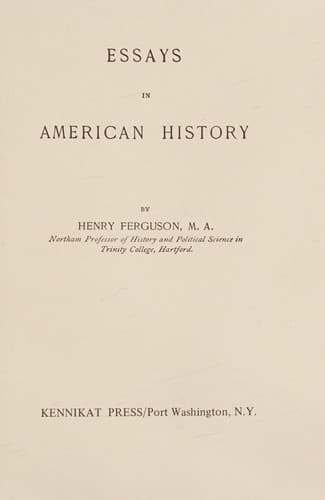
American loyalists; Andros, Edmund, Sir, 1637-1714; Society of Friends -- New England; Witchcraft -- New England
It is, then, not astonishing that our forefathers in New England should
have been victims to a common delusion of their times. We may even
say that the circumstances of their lives were such as to render them
especially liable to it; for though the hardships of the early history
of the settlement grew less as time went on, the life in New England
was, at the best, lonely and depressing. The colonists lived dreary
lives of laborious and uninteresting toil, with few physical comforts,
and with poor and unvaried diet. They had few amusements, little or
no recreation, and they were constantly in face of difficulties,
constantly exposed to danger. Their houses were on the verge of the
mysterious forest, where strange sights and sounds were to be seen
and heard, where dwelt the Indians, often hostile and always a source
of uneasiness. They had few books, and those they had were not of a
character to draw them away from the contemplation of themselves.
The Bible they had, it is true, but to read it for any purpose
except that of spiritual exercise would have been deemed profane.
Sermons of abnormal length and dryness, controversial treatises,
ponderous alike literally and figuratively, and, as we shall see
later, ghastly and blood-curdling accounts of memorable providences,
formed their principal literature. The settlers had been for the most
part emigrants from quiet country towns and villages in England, put
down in the unknown wilderness, to work out, under the pressure of
religious enthusiasm, a new social and religious polity. The life
was small, narrow, and squalid, only redeemed from utter sordidness
by gleams of religious idealism and by the stern resolution of the
better class of the settlers to keep themselves and their neighbors
in the paths of righteousness. Their religion was a sombre Calvinism,
giving more prominence to the terrors of the law than to the comforts
of the gospel. Living as they did in scriptural thought, speaking
in scriptural phraseology, dwelling constantly upon the similarity
of their position with that of the children of Israel, it is not
surprising that they should have carried their intense literalism
into every particular. Their external relations, their religious and
political systems, were ruled by the law of Moses as they imagined
it from their somewhat uncritical study of the Old Testament. Their
Christianity was profoundly internal and introspective, something which
was between each individual soul and the Almighty, rather than a law of
social life. The result of this was twofold. They were led to ascribe
to their own convictions the character of divine revelations, and were
also rendered intensely morbid, sometimes exalted above measure and
sometimes as irrationally despondent. They felt that they were the
chosen people of the Lord, doing a great work for him, in “setting
up the candlestick of a pure church in the wilderness to which the
like-minded might resort”; and this feeling led them to believe that
Public-domain text, read in full here on John Shaqi.
Reviews
Reviews
No reviews yet
Be the first to share your thoughts on this work.
Join the Discussion
Join the discussion
Sign in to leave a comment or review.
Sign InorCreate an account