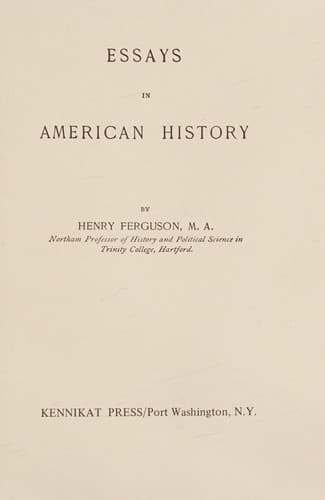
American loyalists; Andros, Edmund, Sir, 1637-1714; Society of Friends -- New England; Witchcraft -- New England
while they failed in chastising sedition in Massachusetts. The result
was that they drove many men, who were loyal subjects of Great Britain
in 1774, into revolution in 1776, while they allowed the rebels of
Massachusetts to wreak vengeance at their will upon those who had been
faithful in their allegiance to their king.[160]
Besides those who were loyalists from conviction and temperament and
those who were almost unavoidably so from the political position they
occupied, there were also men who were loyalists from the profit it
gave them. Such were the holders of the minor offices in the gift
of the royal governors, the rich merchants who represented English
trading-houses, and dreaded war and disturbance. There were others
whose chief desire was to be upon the winning side, who were unable
to conceive the possibility of the defeat of the English government
by a handful of insurgent colonists, and some also who, from local
or personal dislikes or prejudices, or from love of opposition, took
a different side from that which was taken by their neighbors. It
is probable, however, that there were hardly any whose motives were
not to some extent mixed; few on the one hand so disinterested or
so devoted as not to be moved in some degree by self-interest or
prejudice, few on the other hand whose nature was so biassed by
prejudice or so sordid with love of place or pension as not also to be
moved by the higher impulse of fidelity.
Loyalty is hard to define; it is one of those virtues which appeals
not so much to the head as to the heart. Its critics accuse it of
being irrational and illogical, as being based upon sentiment rather
than upon conviction. Yet, in spite of logic and reason, or rather,
on account of its profounder logic and higher reason, loyalty will
hold its own, and strike an answering chord of admiration in the human
heart as long as men appreciate disinterested virtue. It may be classed
with the other unreasoned qualities that men yet esteem, with faith
and truth, honor and courage, decency and chastity. It may be a man’s
intellectual duty to follow the dictates of his understanding and to
act upon his temporary convictions, whatever pain the action cost;
nevertheless, the man whom we respect and follow is not the man who is
always changing, who is easily influenced by argument, but the man who
abides by certain fixed principles, and refuses to desert them, unless
it can be shown him that beyond all chance of mistake they are wrong
and misleading.
Public-domain text, read in full here on John Shaqi.
Reviews
Reviews
No reviews yet
Be the first to share your thoughts on this work.
Elsewhere in the archive
Join the Discussion
Join the discussion
Sign in to leave a comment or review.
Sign InorCreate an account