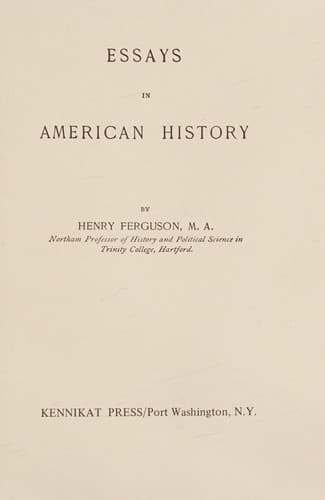
American loyalists; Andros, Edmund, Sir, 1637-1714; Society of Friends -- New England; Witchcraft -- New England
There is no doubt that, in Massachusetts at least, most well-to-do
persons considered the agitation at first to be merely political,
the usual device of the “outs” against the “ins”; they laughed at
the loud talk of some of the orators, and considered that it was put
on for effect.[157] When, in addition to this, the cause of American
rights was disgraced, year after year, by riots, murder, arson, and
sedition, those who were entrusted with the responsibilities of office,
however much they sympathized with the abstract principles that were
upheld by the popular leaders, were prejudiced against the concrete
application of them.[158] We should also remember that, down to the
time of the battle of Bunker Hill, if not later, all parties united
in the most loyal and devoted language. The rights that were claimed
were not the rights of Man, but of “natural-born subjects of the king
of Great Britain”; the king was always described as “the best and
most generous of monarchs,” and separation was never mentioned as a
possibility in any public utterance. War was looked forward to by some
of the most eager as a means of bringing the ministry to terms, or as
an unavoidable necessity if the unconstitutional taxation was persisted
in; but, up to the very last, most men agreed with Richard Henry Lee,
who said to Adams, as they parted after the first Continental Congress
in 1774: “All offensive acts will be repealed--Britain will give up her
foolish project.”[159]
When the most ardent American patriots used this language, and used
it sincerely, it is not remarkable that those who formed the opposing
political party, who were conservative when these were the radicals,
should have felt that they were bound by their duty to their king
and country, or that they should also have felt that the disorderly
actions and the factious attitude of some of the extreme patriots in
Massachusetts and elsewhere were simply seditious. These convictions
were undoubtedly strengthened by the abominable treatment which many
of them personally received. They were not apt to look with greater
favor upon a cause whose votaries had tried to recommend it to their
liking by breaking their windows, plundering their houses, constantly
insulting them, their wives and their daughters, to say nothing of
tarring and feathering them, or of burning them in effigy. The penal
measures imposed by the Parliament upon the town of Boston and the
colony of Massachusetts had been brought upon themselves by the
so-called patriots. One rather wonders at the slowness and mildness
of the British government, and at their miserable inefficiency, than
at any repressive measures that they undertook. They deserved to lose
the colonies for their invincible stupidity, which led them from one
blunder into another; they irritated when they ought either to have
crushed or conciliated; they tried half-measures when vigorous action
was necessary; they persisted in affronting all the other colonies
Public-domain text, read in full here on John Shaqi.
Reviews
Reviews
No reviews yet
Be the first to share your thoughts on this work.
Elsewhere in the archive
Join the Discussion
Join the discussion
Sign in to leave a comment or review.
Sign InorCreate an account